The Waitlist
Be there when the gates open.
Prologue
The Gap
The alarm goes off and you already know what matters today. You decided it last night, lying in the dark: leave at five, be home for dinner, call your mother back.
By nine something has come up, and it’s legitimate. Nobody schedules an emergency. By eleven there are two more, and the five o’clock you promised has quietly become a six o’clock you’re negotiating with yourself about.
At four thirty you look at the clock and start preparing yourself. Not for the hours still ahead. For the text. Running late. Start without me.
You get home at twenty to eight. The kitchen light is on. Someone saved you a plate, and it’s still warm, which somehow makes it worse. You eat standing at the counter, answering the last message of the day.
You never called your mother. You won’t notice that until sometime next week, and by then it will have folded itself in with all the other weeks you meant to.
Here’s the part that matters. Nothing went wrong. Nobody is angry. No one was let down in any way a person could point at. It was a good day, and if someone asked, you would say so and mean it.
Now multiply the day you just had. Not by seven. By three hundred and sixty-five.
That’s a year. Not a bad year, either. A year of days precisely like this one, each of them defensible, all of them full. At the end of it you would have trouble saying what changed.
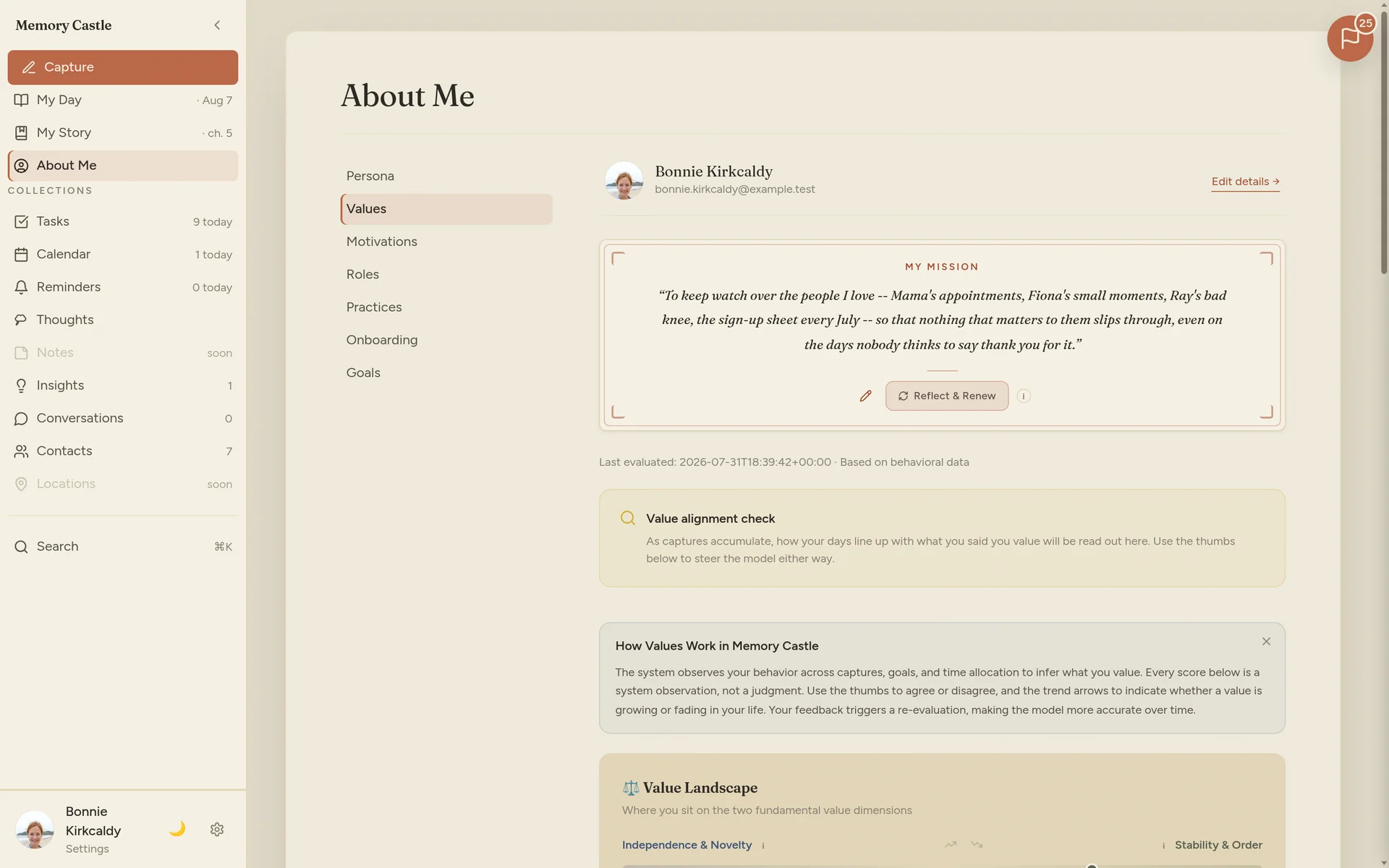
If someone stopped you tonight and asked who you are, you’d have an answer ready, and it would be a true one. Present with the people who matter. Steady about the things you said you’d do. Moving toward something you actually chose. Ask your calendar the same question and it answers differently. It describes someone reachable by everyone except the people closest to them. Someone whose days are full and whose years are hard to account for.
Both answers are accurate. That’s what makes this so hard to catch.
Nobody in your life can point it out, either, because nobody stands close enough to see both answers at once. Your colleagues see the one who delivers. Your friends see the one who shows up. The people at your table see the one who came home. None of them sees the whole, so none of them can hand back what you can’t see yourself.
That distance has a name, and this is the only place this book will define it. The gap is the space between who you say you are and what your days actually hold. Everyone has one. Most people never see theirs, because seeing it means holding both answers up at once, and nothing in an ordinary life ever does.
Closing the gap doesn’t start with a plan, or a system, or a better version of you. It starts with a question nobody has asked you in years. Who are you, right now, before anyone needed you to be anything else?