Skip to content
Memory Castle
Join the waitlist
LOOK INSIDE ▾

Your story, kept safe

Memory Castle

Thistle Intelligence

One gesture. Say it, type it, snap it.
Your day, given a shape — tasks, calendar, and thoughts, side by side.
The observation it's about to leave you — quietly, when it matters.
Who you are now, and who you’re becoming — both named, both kept.
Every observation shows its work — the why is always one tap away.
When a chapter closes, it walks you back through what mattered.
Then it writes the chapter — your weeks, told back as one story.
And the next chapter opens with what you chose to keep close.
1 / 91 of 9 — The book cover. Select Look Inside, above the gallery, to begin reading.
Alpha edition Web · iOS · Android

Memory Castle

A Personal Growth Management System — for the gap between who you say you are and what your days actually hold.

“The first reviews will be written by the alpha testers. One of them could be you.”

Built for everyone whose best ideas die in the shower.

You’ve watched a whole week disappear and couldn’t say afterward where it went. You’ve kept a journal that never noticed you’d written the same worry eleven times. The tools kept you organized. They never once noticed you.

Memory Castle takes whatever you hand it — a voice note, a sentence, a photo of a whiteboard — and does two things no tool ever did. It remembers for you: what you’d forgotten comes back on its own, at the moment it matters. It pays attention to why — comparing what your days actually hold against who you said you wanted to become, and saying so, quietly, first.

Not just what to remember. What to become.

Join the waitlist

Be there when the gates open.

Alpha and beta seats are limited and by application. Waitlist members are invited first.

Look inside the book
Platform
Web, iOS & Android
Your story
Never sent anywhere to be read.
Privacy
Never sold, never will be.

You’ve done this before.

You’ve bought the planner. Downloaded the app. Set up the system that was finally going to stick — and watched it become one more place your life doesn’t live. Those tools failed structurally, not personally: they made you do the hard part, and then they measured the showing up — never the becoming.

Managing what you do is productivity. Managing who you become is personal growth management.

You’ve been told every action is a vote for who you’re becoming. Nothing you ever owned counted the votes. Memory Castle counts them — that’s the whole inversion: you live; it files, notices, compares what your days actually hold against the person you said you wanted to be, and speaks up when the two drift. Its only measure of success is whether you’re becoming that person. Not how much you did — who you became.

When you go quiet — everyone does — the only judge waiting at the door is you. The old tools armed that critic: the broken streak, the red badge, the overdue count. The castle hands the critic nothing. It greets you, it doesn’t grade you — it was never built to be a judge. It was built to be a mirror, and to help you when you don’t like what you see.

The loop

  1. 1

    Start Where You Are

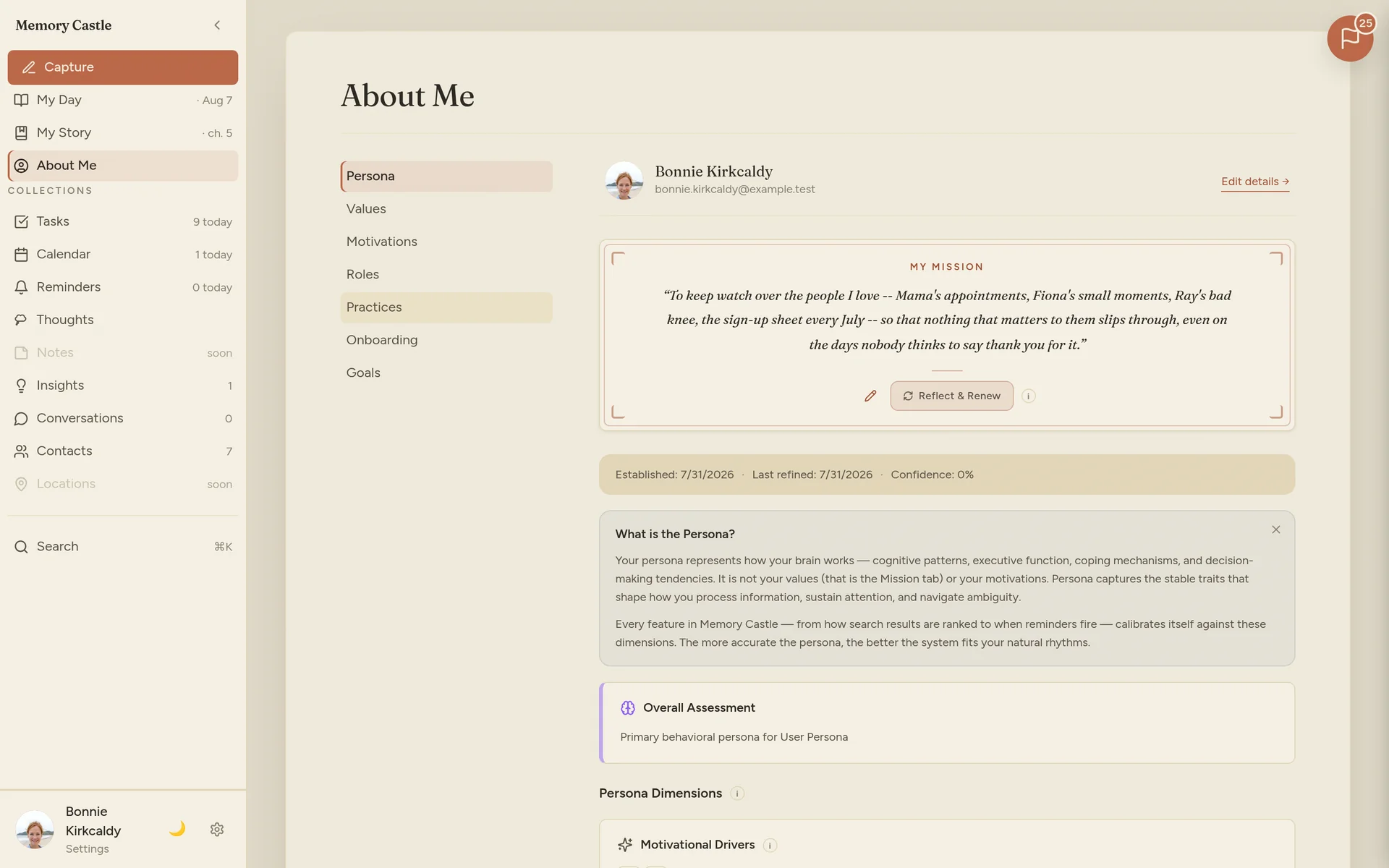
    Memory Castle opens by getting to know you: who you are right now, then who you want to become. Mission, roles, goals — the stated self the whole system aims at. It’s the last time it asks you to fill anything out. From here, you just live.

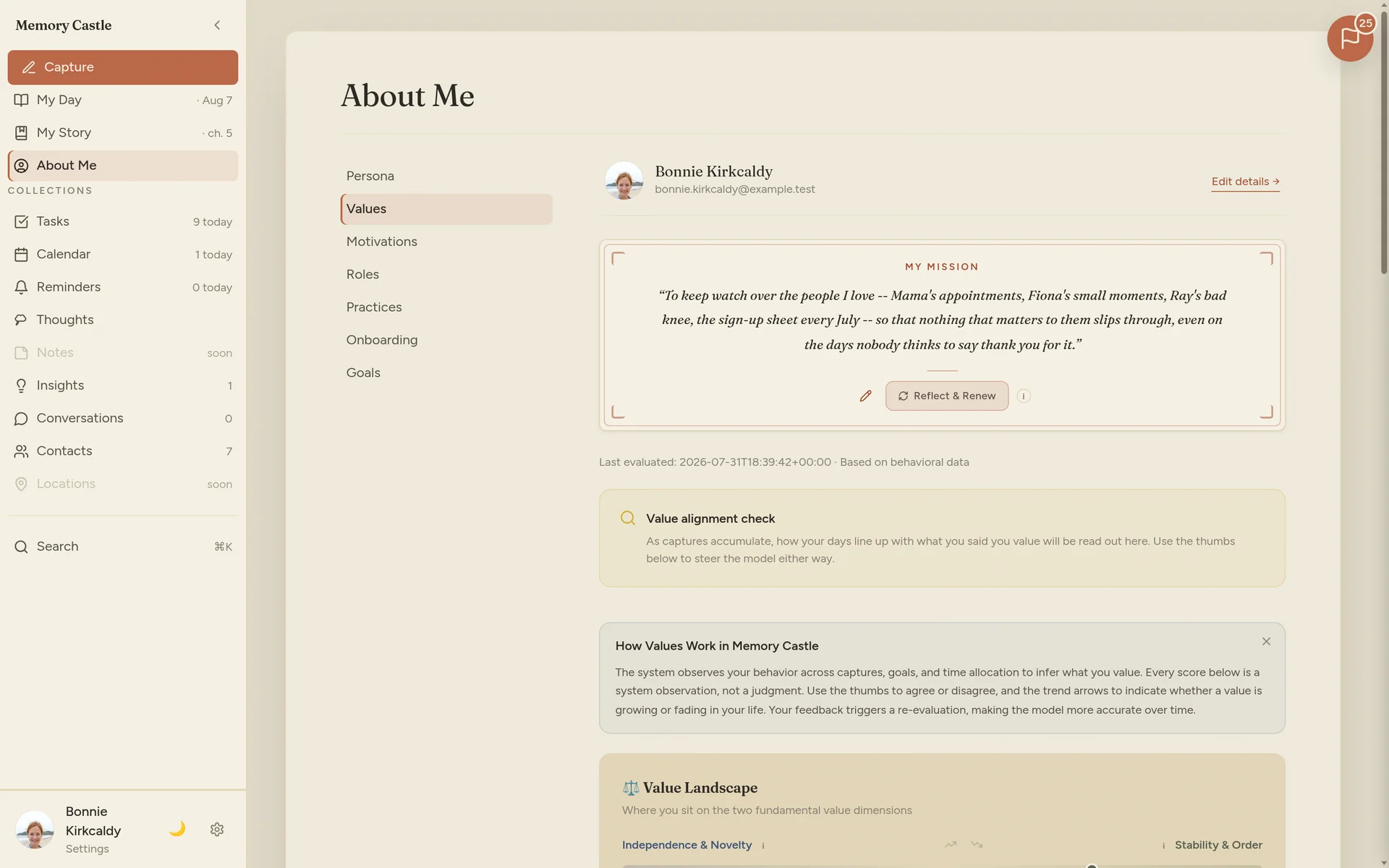
    The mission statement comes last here. That’s on purpose. Self-help tradition demands it first, the hardest blank page in the genre, written before anything knows you. Memory Castle never asks for it up front. You start with the smaller, truer pieces. The values you’d protect if life made you choose. The whys underneath, some declared, some noticed in how you live and offered back for you to confirm. When there’s finally enough of you on the page, Memory Castle helps you write your mission, from your own material instead of from nothing. It hangs where you’ll see it, one line about why you’re doing this whole life thing, and you can rewrite it the day it stops sounding like you. Most people’s why changes as they do. Yours is allowed to. Your values do quiet work the whole time. When Memory Castle speaks up later, it’s measuring your days against what you said mattered, never against a template. Every other tool opens with what you want to get done. This one takes its time learning who you want to be, and why. Memory Castle never forgets your answer.

    the mission, written last, from everything you’ve already told it
    the mission, written last, from everything you’ve already told it

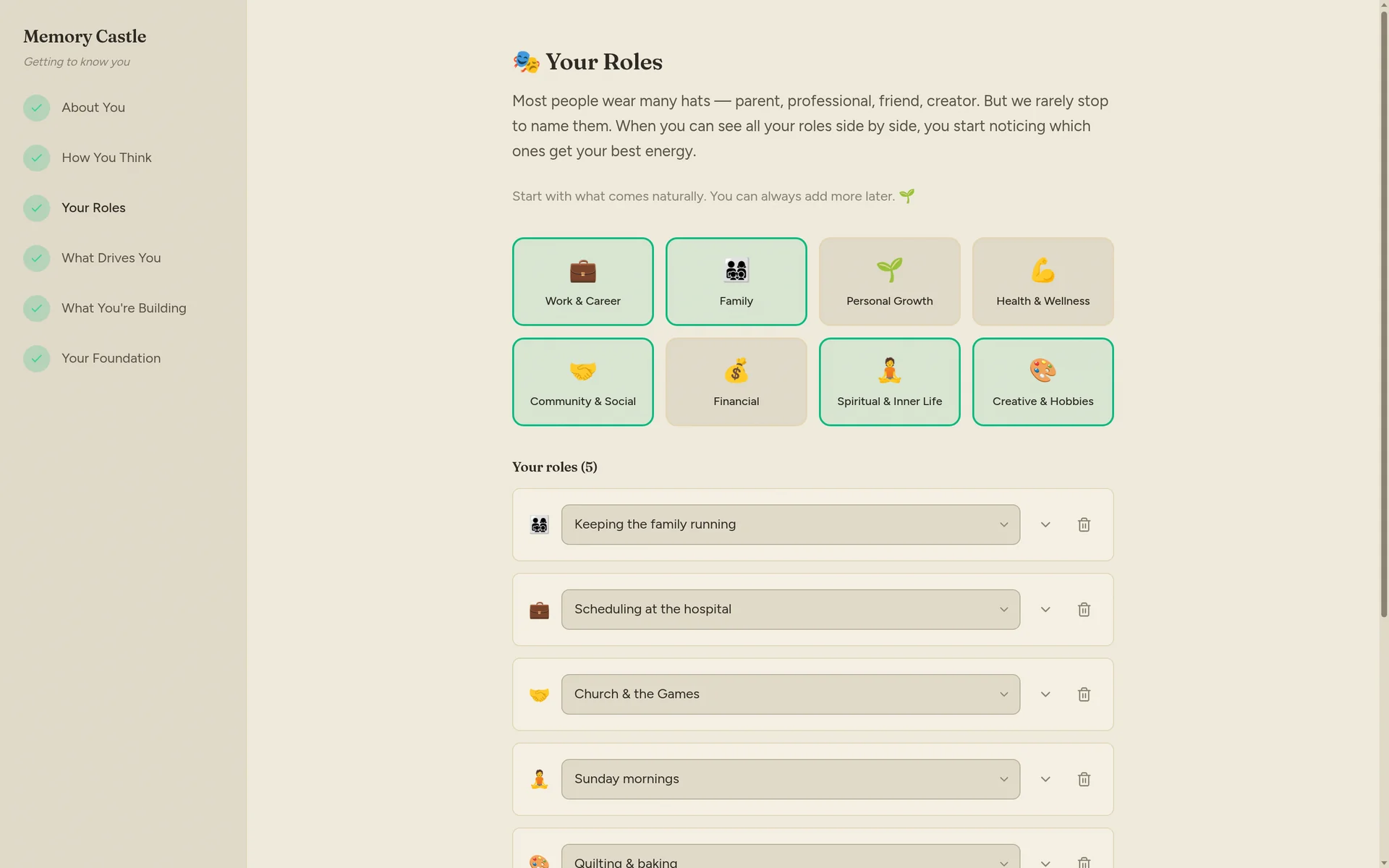
    You’re more than one person. There’s the one at work, the one at home, the one your friends know. Most apps flatten all of that into a single to-do list. Memory Castle keeps the parts distinct. It calls them roles, and choosing yours takes a minute: you pick from a short list, and a handful is plenty. From there, it pays attention. As it gets to know you, it suggests roles you’ve been living but never named. Because it knows the parts of your life, it notices what a checklist never could: one role eating every day you have while another goes quiet. It says so before you would have seen it yourself.

    the roles chosen, each one a lens on the same life
    the roles chosen, each one a lens on the same life

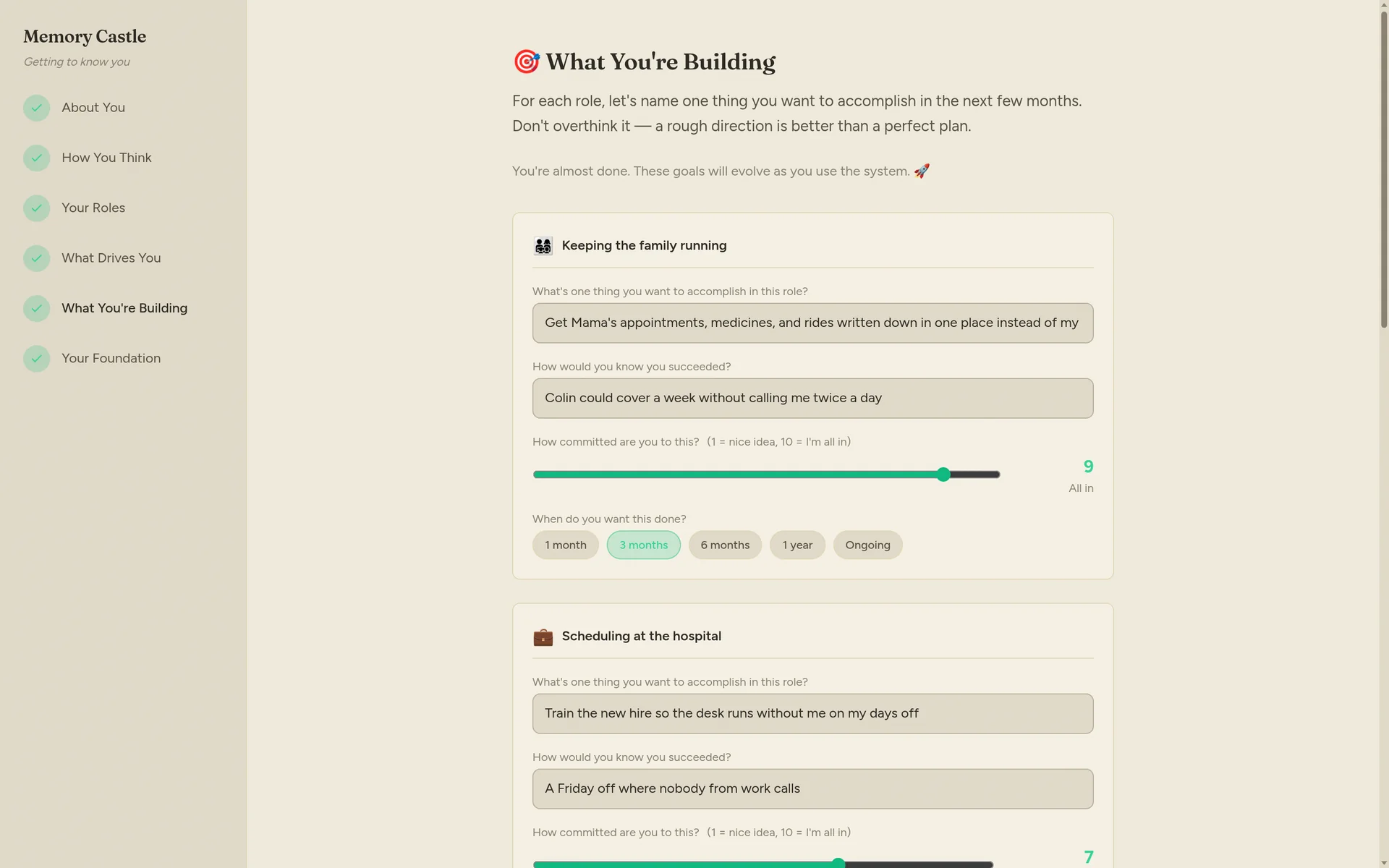
    Anyone can write down a goal. New Year’s resolutions get written every January and forgotten by March. What makes a goal real is how much you actually care, and that’s the question other apps never ask. Memory Castle asks. Every goal you set carries your honest answer: how much does this one matter? That answer decides what stays close, what gets room in your days, and what deserves a word when it starts to slip. You don’t have to know every goal up front, either. Memory Castle watches what you keep coming back to and suggests the goal you’ve been circling without ever naming it. Some goals you’d cross a room for. Some you’d cross an ocean for. Memory Castle knows the difference.

    each goal paired with how much it actually matters
    each goal paired with how much it actually matters

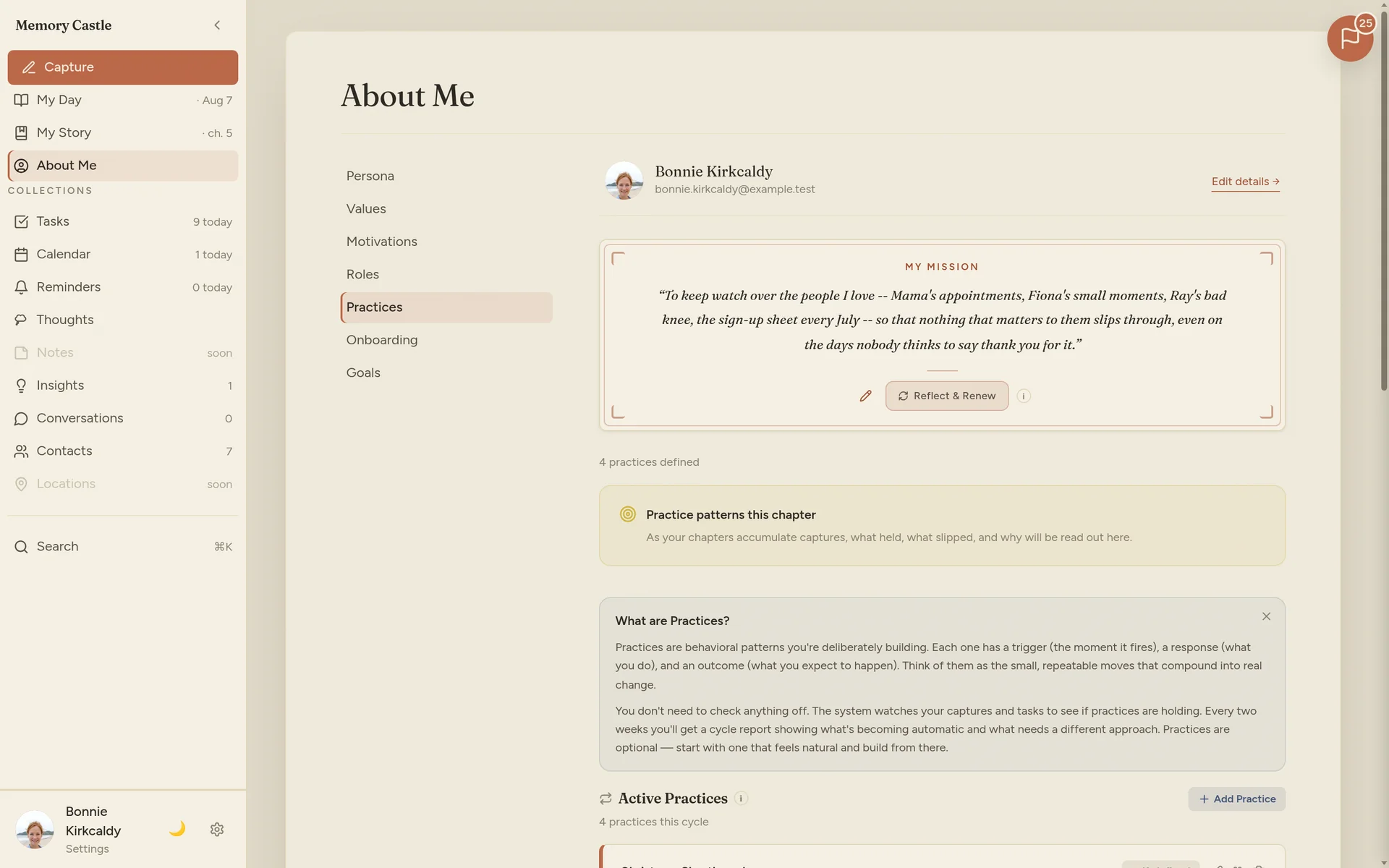
    A practice is a habit with a hypothesis. When the morning is quiet, I write. When work ends, I walk. You state it once, the way you’d state a small bet with yourself. You never have to track it. You can, if checking the box is part of the satisfaction. But the system doesn’t depend on you remembering to, and that’s the difference, because mandatory tracking is where every habit app lost you. The streak needed feeding. The checkbox needed checking. Keeping the record became one more habit to fail at. Memory Castle fills the record in from your life. You live out loud, and when a capture shows the practice happened, it counts, on its own. When the chapter closes, you see the honest number. How often the bet actually held. Not a verdict. A reading. The habit tracker that finally fills itself in.

    each dot filled in by a capture, never a checkbox
    each dot filled in by a capture, never a checkbox

    Start Where You Are: your first five minutes inside.

  2. 2

    Live Out Loud

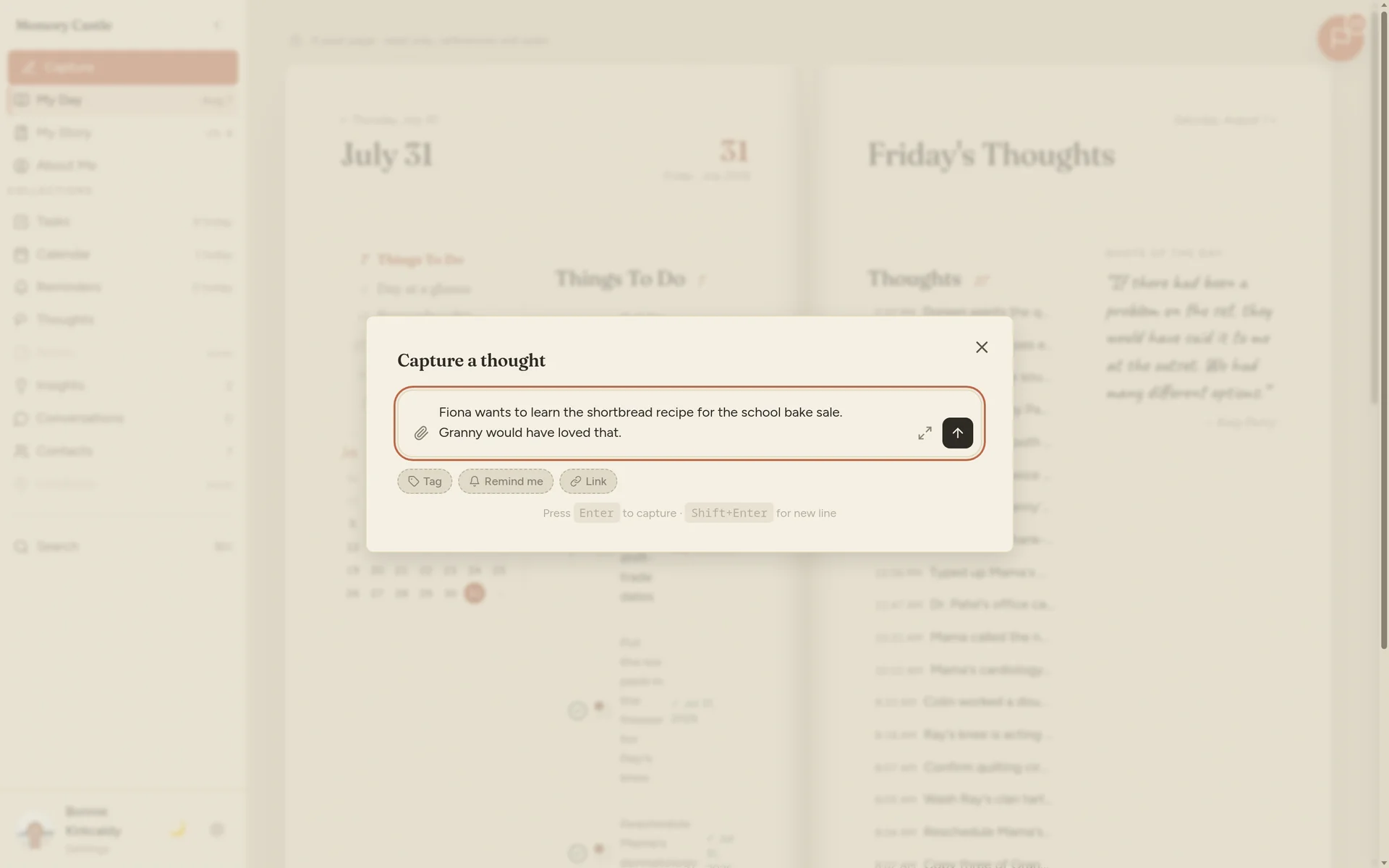
    You’ve told Memory Castle who you want to become. Your days are the evidence. But days vanish when keeping them costs too much: a folder to choose, a form to fill, a decision about where things go. So Memory Castle made capture zero-friction. Notice something, catch it in a moment, get back to living. Memory Castle does the rest.

    Your best thinking doesn’t happen at a keyboard. It happens in the car, on a walk, in the shower with nowhere to write. Memory Castle keeps a mic one tap away. Tap it, say what you’re thinking, and forget about it for now. The thought is transcribed, timestamped, and kept without another touch. It isn’t a recording in a pile. It’s a piece of your story now, and the day it matters, Memory Castle brings it back to you.

    say it: the mic is always one tap away
    say it: the mic is always one tap away

    Some thoughts arrive half-formed. A sentence. A fragment. A name you don’t want to forget. Memory Castle takes them exactly that way. Type it and you’re done. Nothing to file, nowhere it has to go. Half a thought isn’t wasted here: weeks later, when the other half shows up, Memory Castle notices they belong together.

    typed and filed, already timestamped
    typed and filed, already timestamped

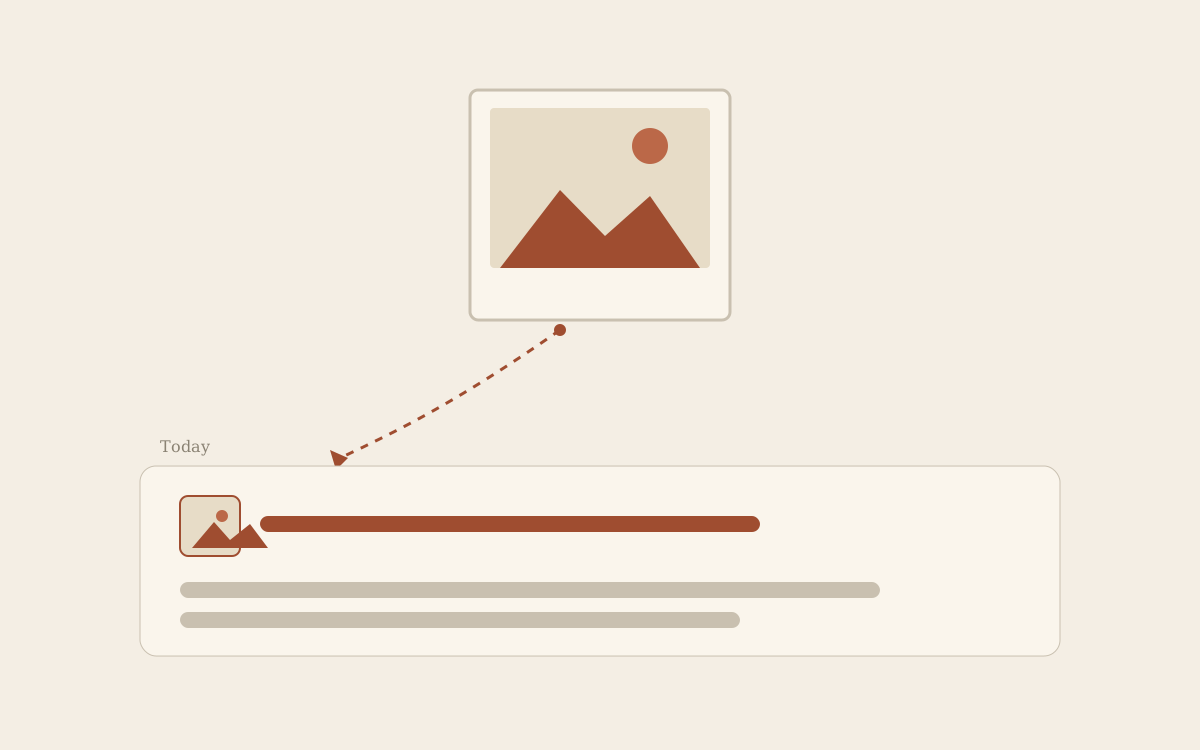
    Not everything worth keeping arrives as words. A birthday cake mid-song. Friends at the table. The whiteboard before it’s erased. The receipt you’ll need in April. Snap it and put the phone away. The picture lands with the day it belongs to, beside everything else that happened. Memory Castle knows what it’s looking at: the words on the board, the number on the receipt, whose birthday it was. No tags, no captions, no explaining. That is what zero friction actually means. A camera roll remembers what you saw. Memory Castle understands what it meant.

    snapped, and already sitting with the rest of today
    snapped, and already sitting with the rest of today

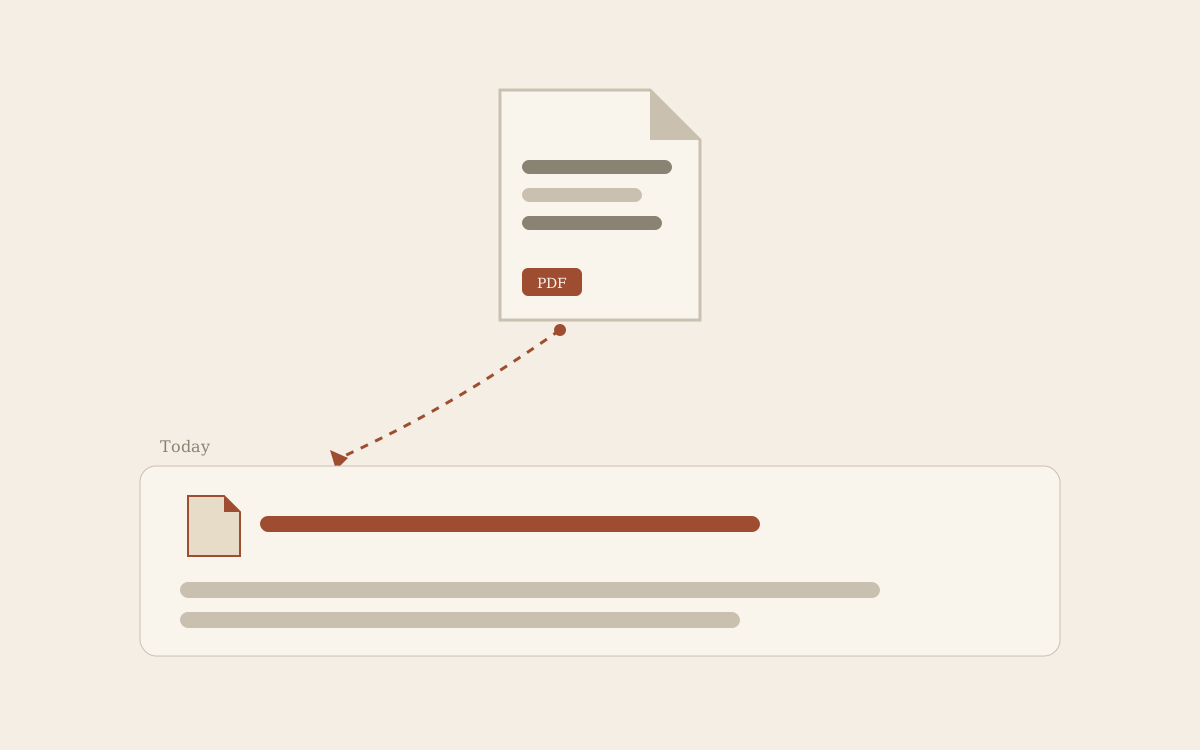
    Your life leaves a paper trail. The PDF from the doctor’s office. The spreadsheet someone sent you. The export from an app you gave up on two years ago. Drop them in whole. No unpacking, no renaming, no deciding where things live. Files like these usually land in a folder and are never opened again. Memory Castle opens them. It reads what’s inside, and what it reads becomes part of what it knows about you. Your history doesn’t have to be reorganized to count. It just has to arrive.

    the whole file, taken in exactly as it is
    the whole file, taken in exactly as it is

    Live Out Loud: a day, captured as it happens.

  3. 3

    Hear Yourself Out

    This is where it pays off. Memory Castle knows who you’re trying to become and sees what your days actually hold. When the two drift apart, it speaks first. You’ve never owned an app that starts the conversation. What it brings are observations, never orders. It proposes. You decide.

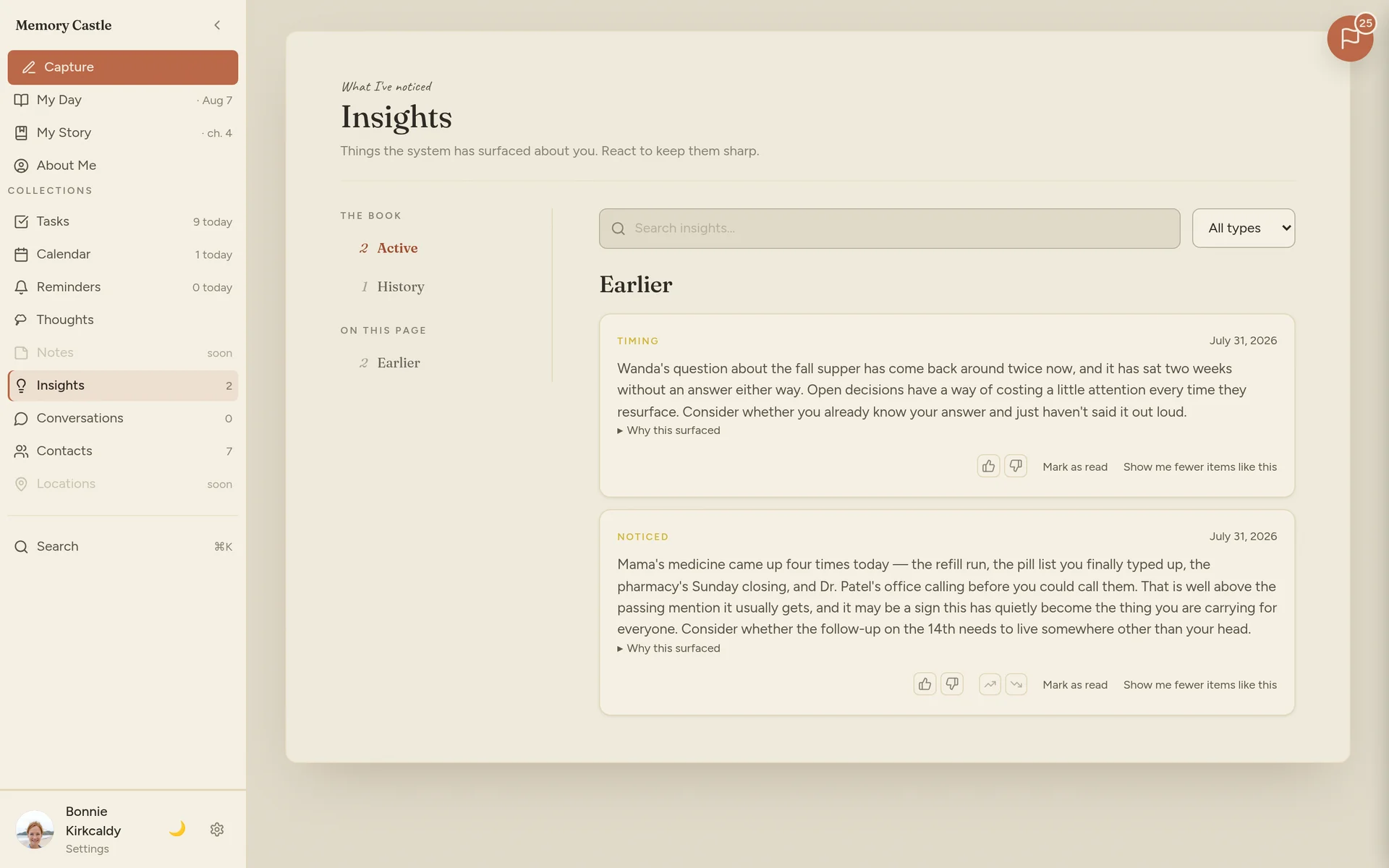
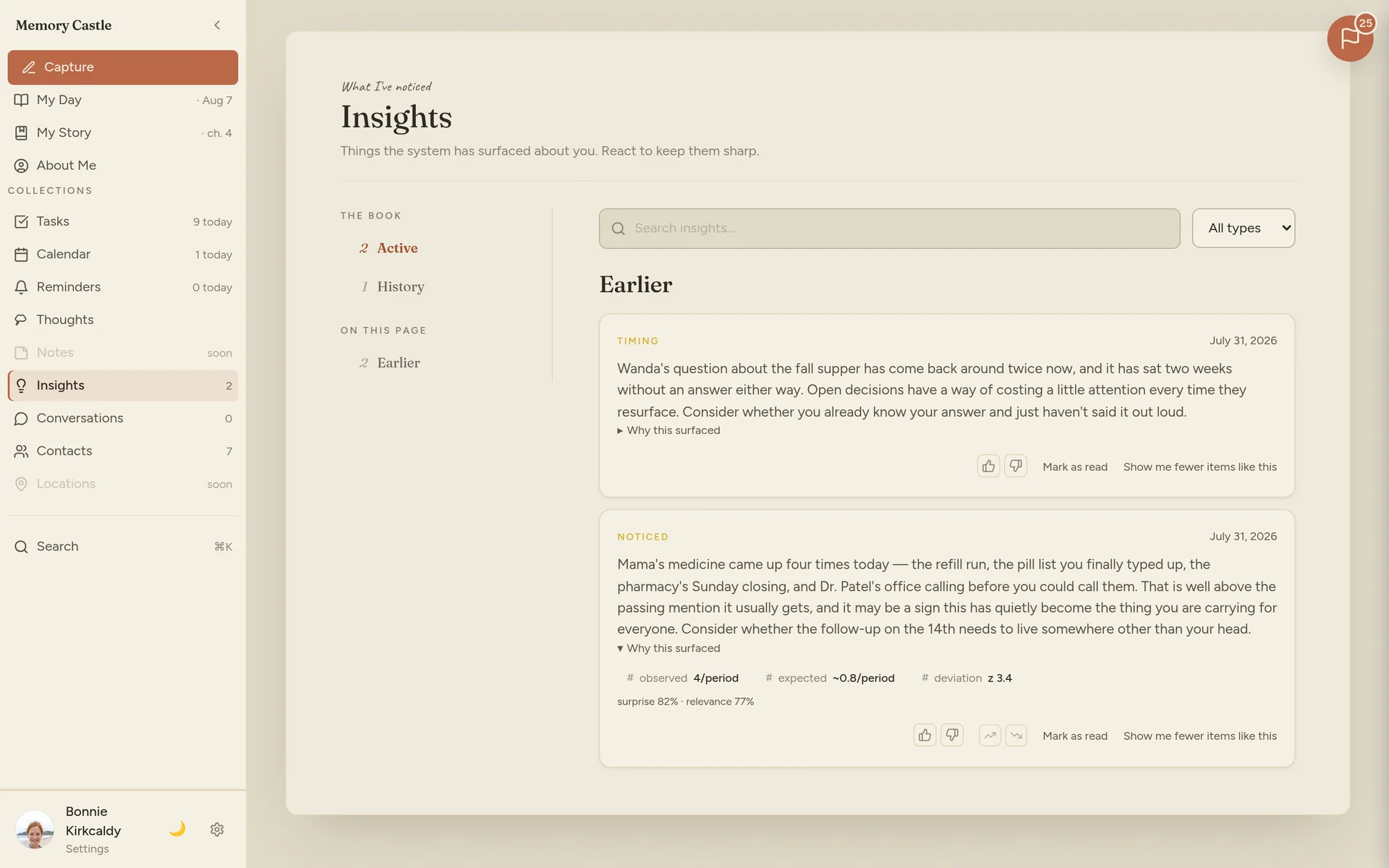
    An observation is not the app’s opinion. It’s your own life, noticed. It notices more than one kind of thing. The drift: you said family mattered most, and three weeks of your days said otherwise. The echo: the worry you captured in March is back in June, and this time something caught it. The promise: the thing you said you’d do is coming due, and it hasn’t been forgotten. Memory Castle reads your days against who you said you want to become, and when something true comes into view, it hands you a card. A card, not a report. Clarity, not instructions. What you do with it is yours.

    said once, when it’s actually relevant
    said once, when it’s actually relevant

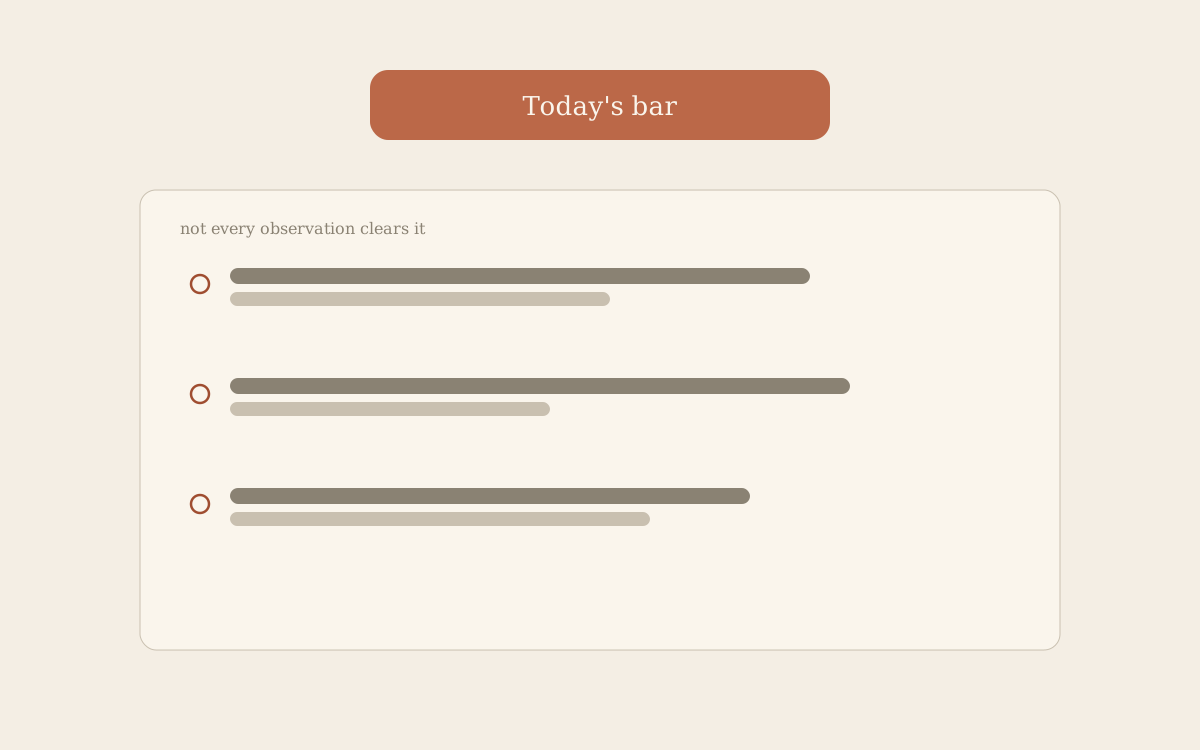
    Every app on your phone believes it deserves your attention. Memory Castle assumes it doesn’t. Before an observation reaches you, it has to pass a test: is this surprising enough, and does it matter enough, to be worth interrupting you right now? That isn’t a mood. It’s math, and every observation takes the test. It isn’t one bar for everyone. It’s your bar, set by your personality: people who want quiet get a quieter castle, and people who want more hear more. Most days, nothing passes. No card, no ping, nothing. That silence is deliberate. An app that rarely speaks is one you believe when it does. You’ve deleted apps for being needy. This one earns the interruption, or it stays out of your way.

    only what clears today’s bar reaches you
    only what clears today’s bar reaches you

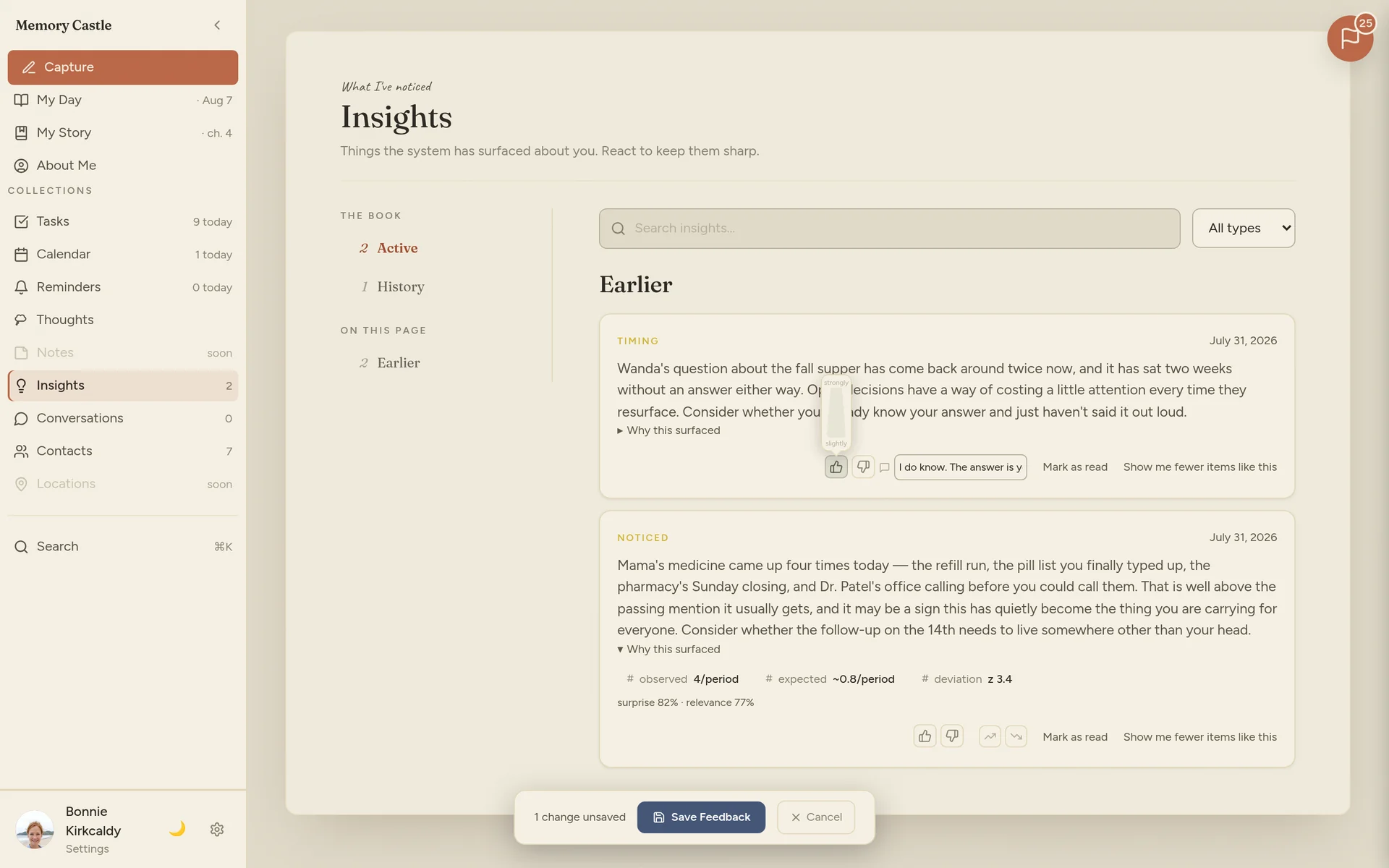
    Every observation ends with a question. Was this right? Agree, disagree, add a note, or let it pass. Your answer does something real. Before an observation reaches you, it has to be worth the interruption. You decide what’s worth it. Give one a thumbs-down and similar observations have a harder time reaching you. Thumbs-up and they get easier. Nothing is being trained here. No AI is studying you. Privacy isn’t a feature here, it’s the stone the castle is built from. There’s just math, and you adjust it the way you’d nudge a thermostat that runs warm. Over time the observations get sharper and the timing gets better. Better means yours. Some people want a castle that speaks once, softly. Some want to be reminded three times because they know exactly who they are. Whichever you are, that’s what it becomes. Every card shows the evidence behind it, and everything the castle knows came from you. A year in, this isn’t the same product you signed up for. It’s the one you tuned.

    your answer tunes what reaches you next time
    your answer tunes what reaches you next time

    Hear Yourself Out: the first time it speaks.

  4. 4

    See How Far You've Come

    Becoming is slow. That’s the problem with it, and it’s the reason most self-improvement dies in the middle. You didn’t quit the gym because it wasn’t working. You quit because you couldn’t see it working. Day to day, change is invisible. You look the same as yesterday. The list on your phone only shows what’s still not done. Nothing anywhere shows what’s different because you kept going. Your Story is that missing page. Here, chapters of your life close honestly, bind into a growing book, let you set down what’s finished, and come back to you written. It shows you what already changed.

    The review is a conversation, not a form. Memory Castle goes first. It lays out the chapter just ended. The highlights that deserve one more look. Every goal, one at a time, with the plain truth of what moved and what didn’t. Every practice, the ones that held and the ones that slipped. Some entries will say no progress recorded. Notice what happens when they do. Nothing. The same calm voice that reports everything else, and a Skip button if you’d rather keep moving. Respond where you want to. Agree, disagree, correct it. That’s the tuning, at the exact moment you’re paying attention. Then three short fields, every one optional. What worked. What didn’t. What surprised you. Ten minutes with your own life, told honestly. At the bottom, one button. Turn the Page.

    each entry walked through, then the page turns
    each entry walked through, then the page turns

    One page becomes two, then ten. Memory Castle binds them. Your chapters sit on a spine, in order, each with the name you gave it. Some people name them like eras. The Move. The Comeback. Some never name them at all, and the dates do the talking. The hard chapters stay bound beside the good ones. Nothing gets torn out, and nothing is held against you. The pace is yours. A chapter can be a single day, a week, or the two weeks most people settle into. Your life decides how fast the pages turn.

    named or dated, every chapter stays bound in order
    named or dated, every chapter stays bound in order

    Closing a chapter means making decisions. Each goal, each thread, each open loop gets one question. Does this come with you, or has it run its course? What comes along is carried on purpose, not dragged by default. What stays behind is released, not abandoned. The difference matters. Released means you looked at it, thanked it, and set it down. The chapter prints both lists, carry and released, right there on the page. Read them a few chapters later and you’ll notice something. The released things didn’t haunt you. Letting go, it turns out, is also progress. No app has ever told you that before.

    carried on purpose, released without a fight
    carried on purpose, released without a fight

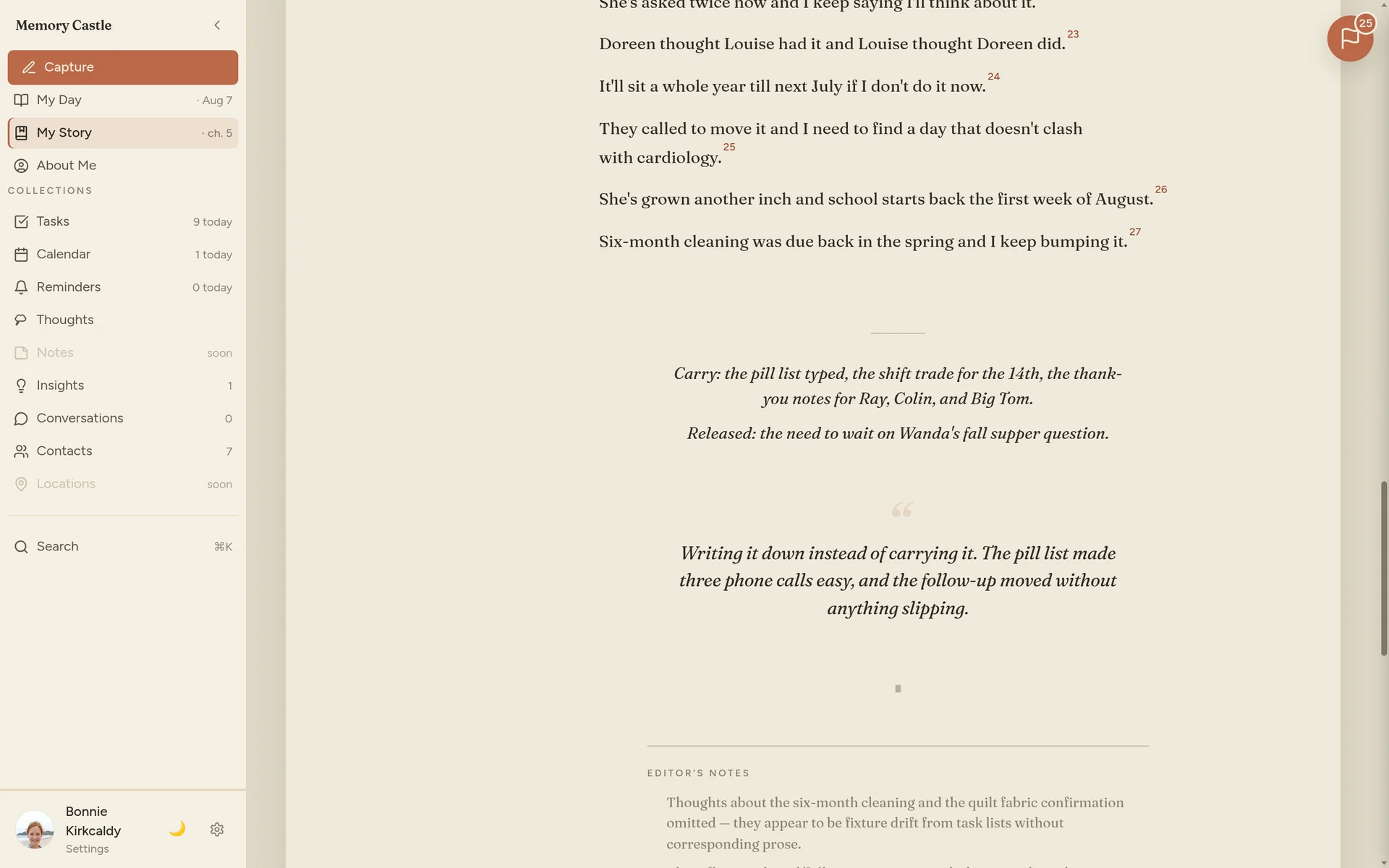
    When a chapter closes, the editing begins. Memory Castle takes your scattered weeks and gathers them into the threads that were always there. The idea you kept circling gets its own heading. So does the work you finished, and the quiet evening you almost didn’t bother to capture. It even opens with a line pulled from your own words. None of it is invented. Every line ends in a small number, like a footnote, and the footnote is a door. Tap it and you’re back at the original capture, the voice note or the photo, exactly as you caught it in one tap weeks ago. You lived like anyone lives, in fragments. Memory Castle puts them in order. It reads like a story because it finally is one. Your story, written by you, with Memory Castle as the editor.

    your scattered days, gathered into one telling
    your scattered days, gathered into one telling

    See How Far You've Come: months of days, read back.

  5. 5

    Become Who You Said You'd Be

    Some people get their lives planned like they matter. The executive has someone to build the quarter. The athlete has someone to shape the season. Everyone else gets a to-do app. Memory Castle is where that changes. When a chapter of your life closes, the next one gets built the way theirs are, deliberately, around who you said you wanted to be. A short list of goals worth keeping close. A plan with your name on it. A fresh read on where things stand, every morning. This is the treatment reserved for people whose time is expensive. Yours always was.

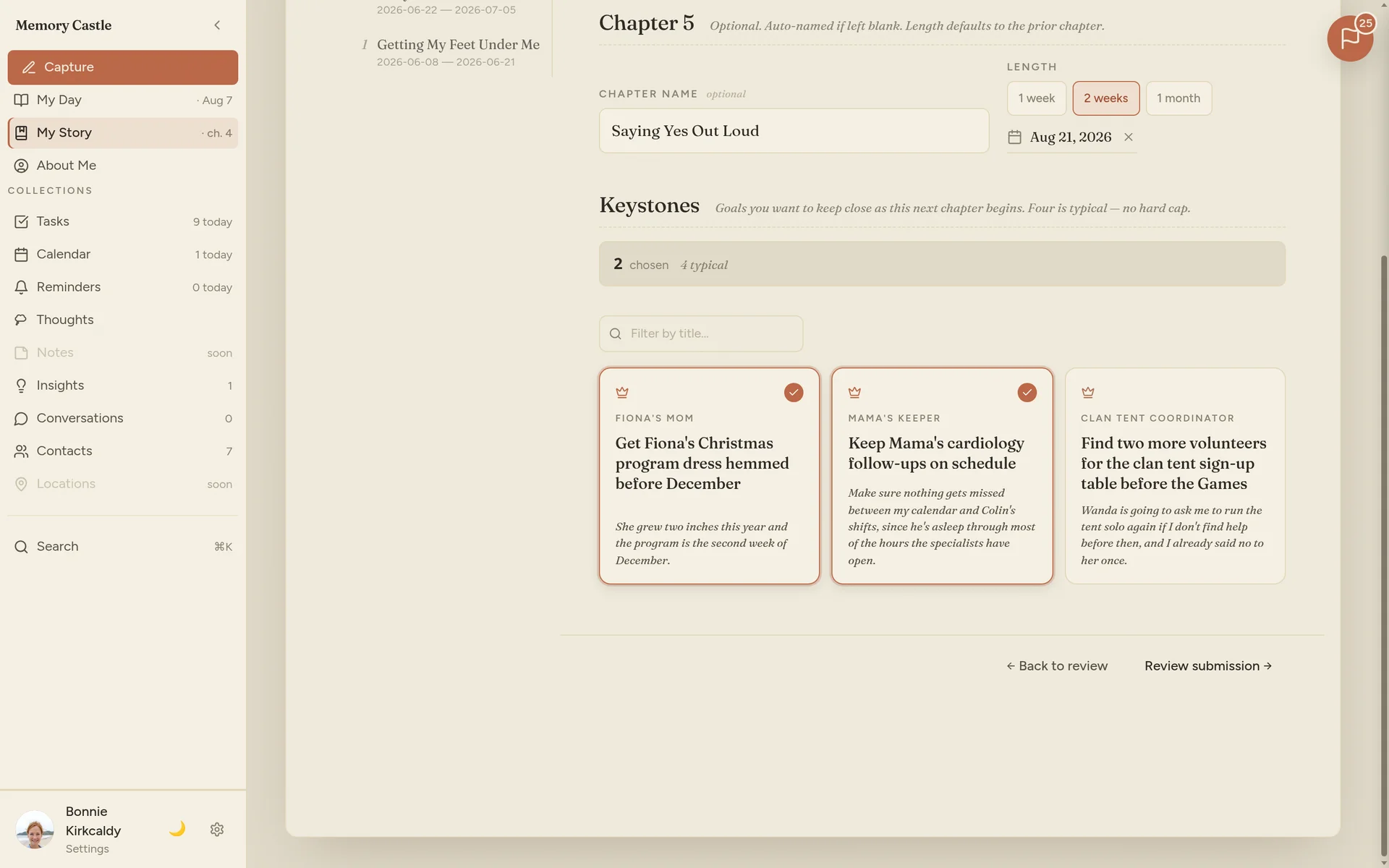
    You can’t work on every goal at once, but every other app expects you to try. The whole list, every day, forever. Memory Castle closes that trap with keystones. A keystone is a goal, focused into a chapter, one of the few you’ll actually keep close for this stretch of your life. When a chapter begins, Memory Castle proposes them, drawn from what you said mattered and what your last chapter showed. Accept them, wave them off, add your own. The word comes from the stone at the top of an arch, the one that holds the rest in place. That’s the job. A few goals, deliberately chosen, holding the chapter up. Everything else waits, and waiting is not quitting. It makes room for the important things that were starving for attention.

    a few, deliberately chosen, holding the chapter up
    a few, deliberately chosen, holding the chapter up

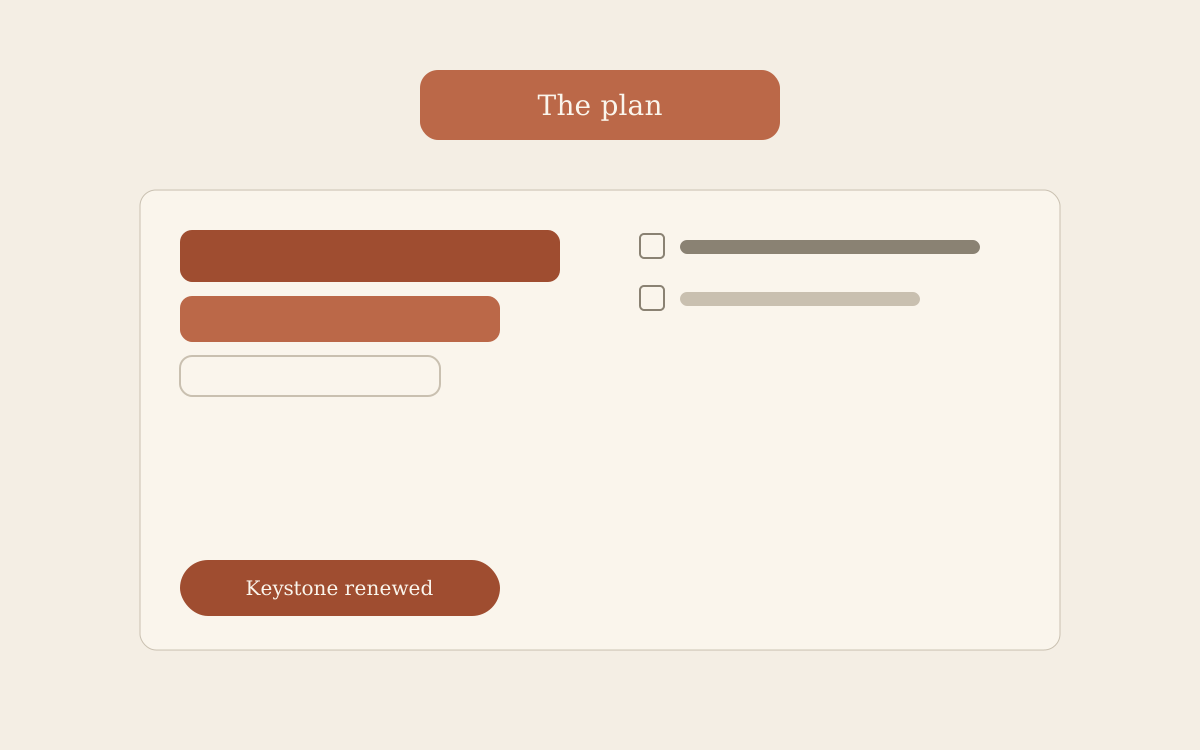
    Intentions don’t survive contact with a calendar, plans do. The goals you kept close become real commitments. Things to do this chapter, time blocked on actual days, priorities sorted with urgent weighed against important, and room protected for the quiet work that never shouts. Then you put your name on it. Not a promise of perfection, a commitment to the person you said you’d be. The plan is defined at the beginning, and it’s set in clay, not stone. When life happens mid-chapter, Memory Castle notices and helps the plan bend. A missed deadline moves, a task you can’t start breaks into smaller pieces with their own checkboxes. Held accountable, never held hostage. That’s a plan you can live with.

    goals sorted, a few real tasks, one keystone renewed
    goals sorted, a few real tasks, one keystone renewed

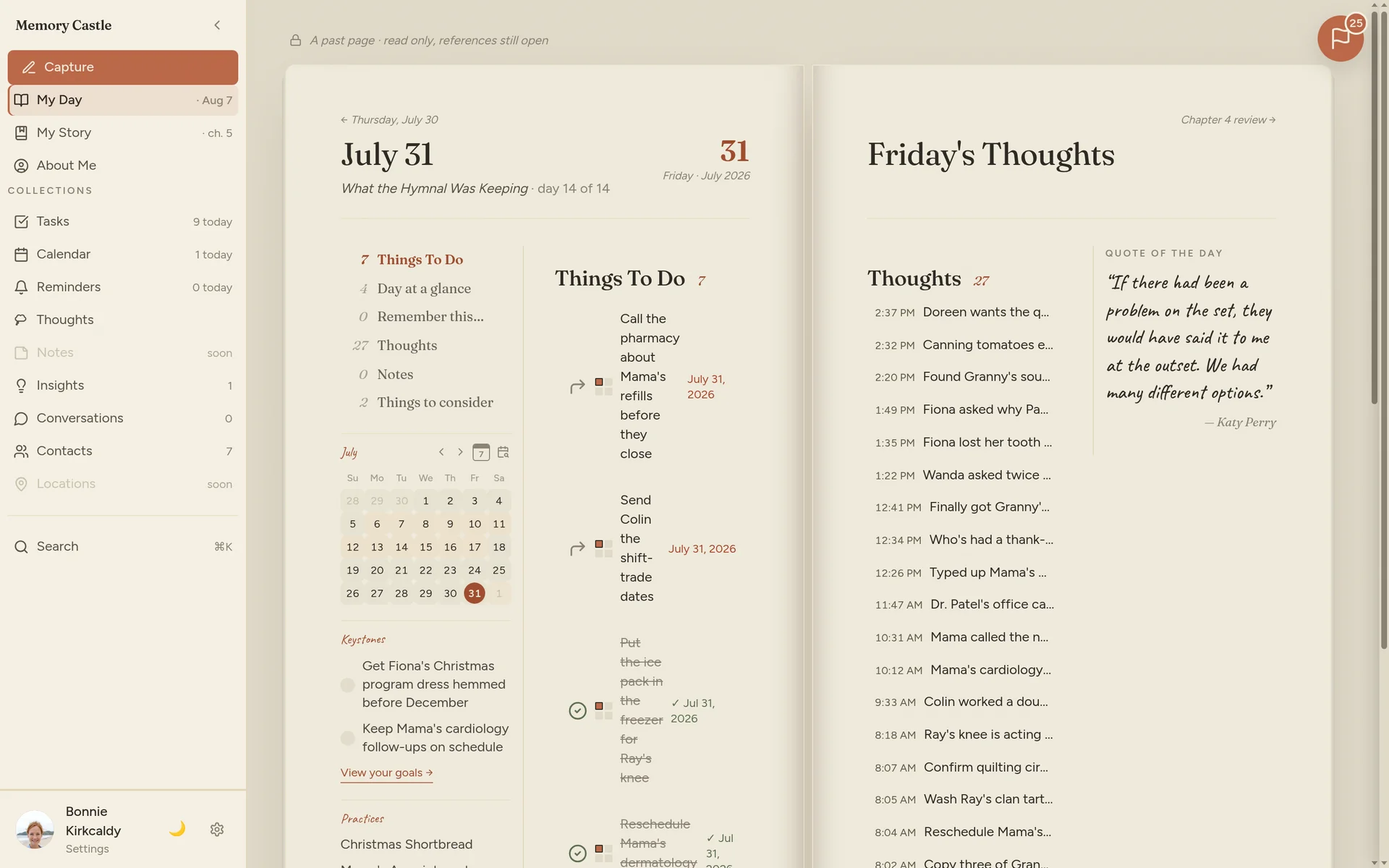
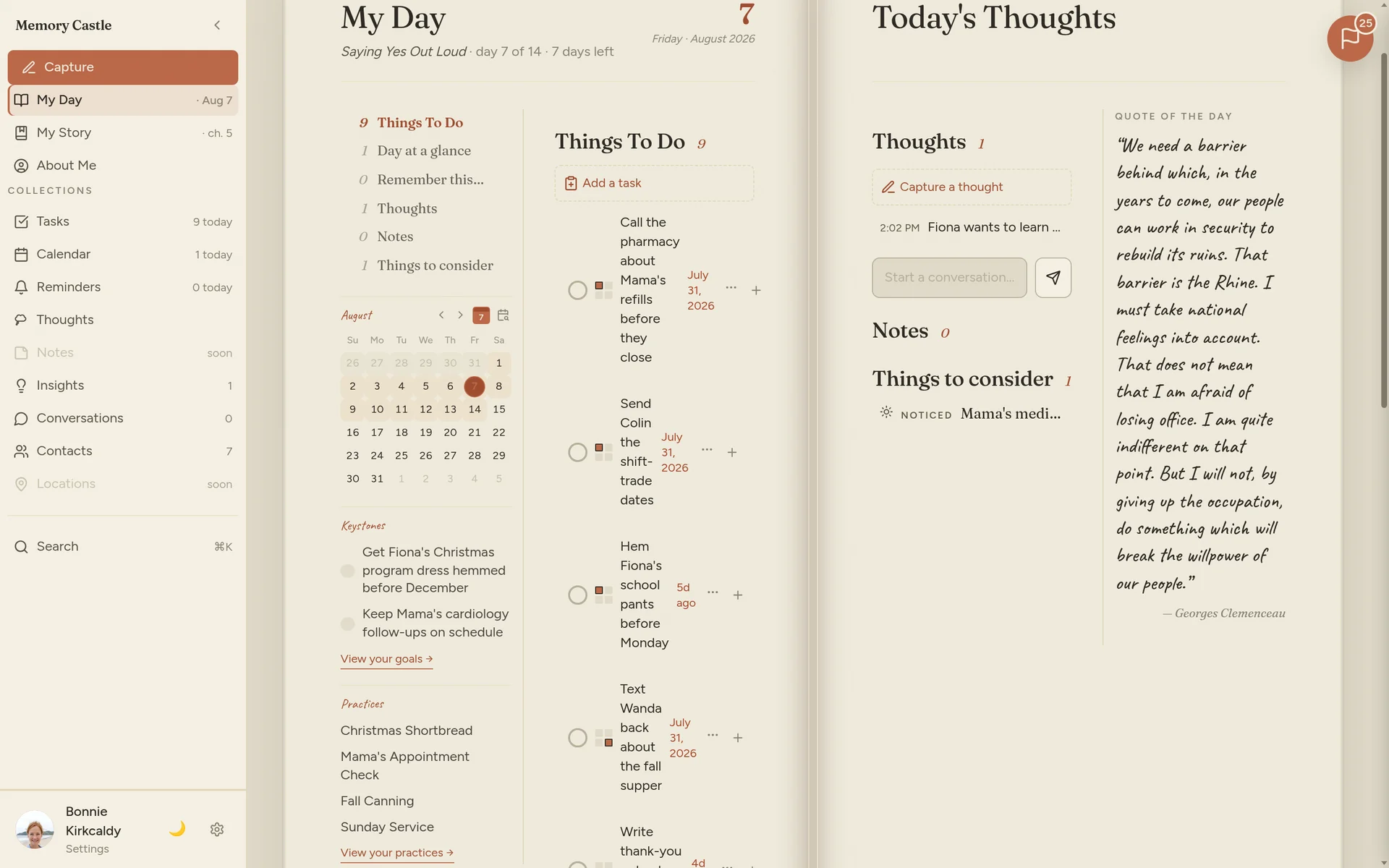
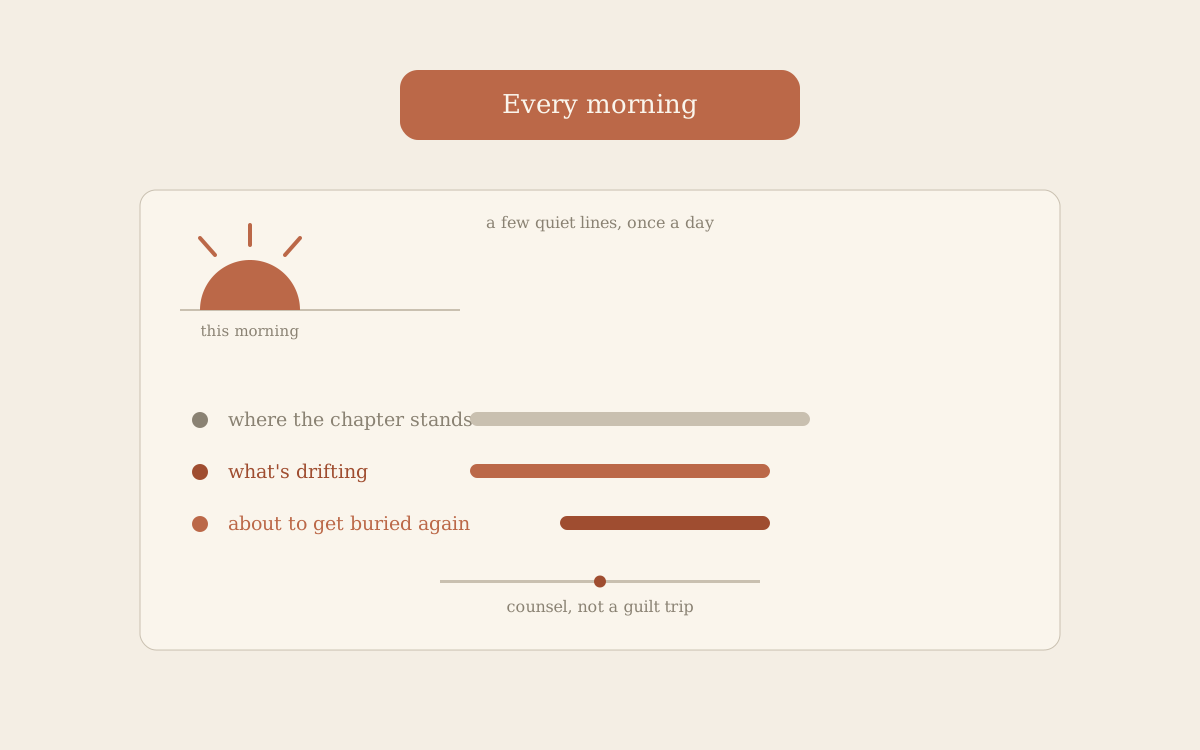
    A plan is only as good as the morning you remember it. Each morning, Memory Castle is ready for you. It has already gone through yesterday’s tasks, events, and thoughts, so it knows what got done and what slipped. It offers counsel, not a guilt trip. A few quiet lines about where the chapter stands, what’s drifting, and the thing you said mattered that’s about to get buried again. It proposes, you decide. Most people’s mornings start with a to-do list. Yours starts with a fresh perspective.

    a fresh read on where things stand, every morning
    a fresh read on where things stand, every morning

    Become Who You Said You'd Be: how a chapter turns.

Your calendar knows your schedule.

Your tracker knows your steps.

Your notes know your ideas.

Memory Castle knows who you’re becoming.

Product details

Category
Personal Growth Management System
Format
Web & mobile app, written like a book
Edition
First edition, still being written.
Pages
Grows every day you do
Takes in
Any file you can think of
Integrations
The tools you already use
Publisher
Thistle Intelligence
Publication date
Never finished, on purpose.
Language
English, first.

About Memory Castle

Memory Castle is a Personal Growth Management System, published by Thistle Intelligence.

Thistle Intelligence builds systems that turn scattered data into meaning people can actually use. Memory Castle is that work aimed at a single life instead of a company. It’s why your story is read inside the castle instead of being sent somewhere else, and why it’s never sold: a system built to help you become someone has no business making money from what it learns about you.

You won’t find a founder bio here. The people using it will be the introduction it needs.

Memory Castle

Not just what to remember. What to become.

The book

  • Look inside
  • About Memory Castle

The castle

  • Join the waitlist
  • Thistle Intelligence

Copyright © 2026 Thistle Intelligence, LLC. All rights reserved.

Privacy

See How Far You've Come

×

Contents

Not just what to remember. What to become.

How days add up to the life you said you wanted.

  1. Title Page
  2. Dedication
  3. Preface Why This Exists
  4. Prologue The Gap
  5. Introduction Personal Growth Management

  1. Start Where You Are
  2. Live Out Loud
  3. Hear Yourself Out
  4. See How Far You've Come · you are here
  5. Become Who You Said You'd Be

  1. Conclusion What Your Days Add Up To
  2. Epilogue Who You've Become
  3. What It Does
  4. Back Cover
Contents
  1. Title Page
  2. Dedication
  3. Preface Why This Exists
  4. Prologue The Gap
  5. Introduction Personal Growth Management

  1. Start Where You Are
  2. Live Out Loud
  3. Hear Yourself Out
  4. See How Far You've Come · you are here
  5. Become Who You Said You'd Be

  1. Conclusion What Your Days Add Up To
  2. Epilogue Who You've Become
  3. What It Does
  4. Back Cover

The Waitlist

Be there when the gates open.

See How Far You've Come

In this book so far: the record exists, and it has started telling you things you couldn't see.

You run into someone you haven’t seen in two years.

They ask what you’ve been up to. You say not much. Work’s busy. Same old.

You get in the car afterward and it bothers you, because not much isn’t true. Two years happened. Things happened in them. You just couldn’t produce any of it standing on a sidewalk with somebody waiting, so you handed over the only summary you had, which was a shrug.

You didn’t misremember. You reported honestly, on the only evidence available to you, and the evidence available to you was a feeling about two years. The feeling said busy. The feeling always says busy.

A new job would have been easy to report. Those come with a date and a title and an announcement. Almost nothing that actually matters comes with any of that. Being more patient doesn’t get announced. Being someone your kids come to first has no start date. Getting your health back before it becomes a thing with a name will never once produce a milestone.

You already know the advice. Reflect. Keep a journal. Do a weekly review. Sit down at the end of the year and take stock. You’ve tried some of it, and some of it more than once, and none of it held, and you filed that under discipline.

Discipline was never the problem. Every one of those methods asks you for the same thing: an account rendered from memory. Nobody can do that. Nobody can audit a span they never recorded. You have never once failed at holding yourself accountable. You attempted it without books.

There’s a second thing all of them needed and none of them said out loud. Reflection needs something that ended. You can’t take stock of a thing still running, which is why reflect more has never worked on a life that doesn’t stop.

Your life has endings. They just aren’t always intentional. A job ends because somebody else decided. A relationship ends. People leave, and some of them don’t come back. A few you chose yourself, and even those arrived with no reckoning attached. The thing stopped, nothing got closed out, and you kept going.

Everything else never even manages to stop. The week rolls into the next week. The bike you were going to fix up is still a bike you’re going to fix up. Goals don’t fail in any way a person actually experiences. They stop coming up.

The endings you do use aren’t yours either. New Year’s Day. A birthday. The Monday the diet starts. Your year ends in December because a Roman decided it, not because anything in your life concluded. Every one of those was handed to you by somebody who never met you, and every one of them is a beginning wearing an ending’s clothes. You’ve started dozens of things on the first of January. You have never once held a closing ceremony for a version of yourself.

In Memory Castle a chapter is an ending you put into your own story. Much like a chapter in a book, it’s how the writer says this much belongs together. Your days don’t come with breaks in them. They run straight on, the way days actually do, and you draw the line anyway, because a stretch with a start and a finish around it has a shape, and a shape is something a person can talk about. Ask someone what happened on the fourteenth of last month and you’ll get a shrug. Ask what that chapter of their life was about and they’ll tell you in a sentence, without stopping to think.

Here the span is yours. Two weeks, which is long enough for something to actually change and short enough that you can still remember it. One week, when things are moving fast. A single day, when the day was big enough to deserve its own page. You decide where one part of your life stops and the next one starts.

You’ve met the reason it matters already, and it has a name. Change blindness: a change that happens slowly enough never registers as a change, because you only ever have today to look at, and today always looks like yesterday.

Memory Castle answered that one way in the last chapter, a fact at a time, while you were busy living. Some things can’t be caught that way at all. A change needs two ends before anyone can call it a change, and in the middle of your life there is only ever one end available. Closing a chapter supplies the other one.

The same reading runs again at the boundary, across the whole span at once, and it reaches things the day-by-day version never could. Where a goal stood when the chapter opened, beside where it stands now. How often a practice actually held, counted from your own days instead of your memory of them. A worry that filled the first week and never showed up again in the last one. Something that never came up once in the entire chapter.

Then comes the difference that matters. In the last chapter Memory Castle said its piece and left you alone. Here it says its piece and waits for you.

The review is a working session, and Memory Castle shows up to it having already done the prep.

Personal growth management calls this the review, and nothing gets reviewed while it’s still running. A period has to close before anybody can say what it came to.

Memory Castle goes first. Here’s what I noticed. The highlights worth one more look. Every goal you were carrying, one at a time, with what actually moved. Every practice, the ones that held and the ones that slipped.

Some of what comes back is better than what you’d have reported. The goal you’d written off as stalled moved further this chapter than in the three before it. The practice you were sure you’d abandoned held nine times. Unfinished things are louder than finished ones, so the only version of the chapter you were carrying around was the loud one. You’d have told the person on the sidewalk that not much happened. You’d have been wrong in both directions.

Then Memory Castle asks what you noticed.
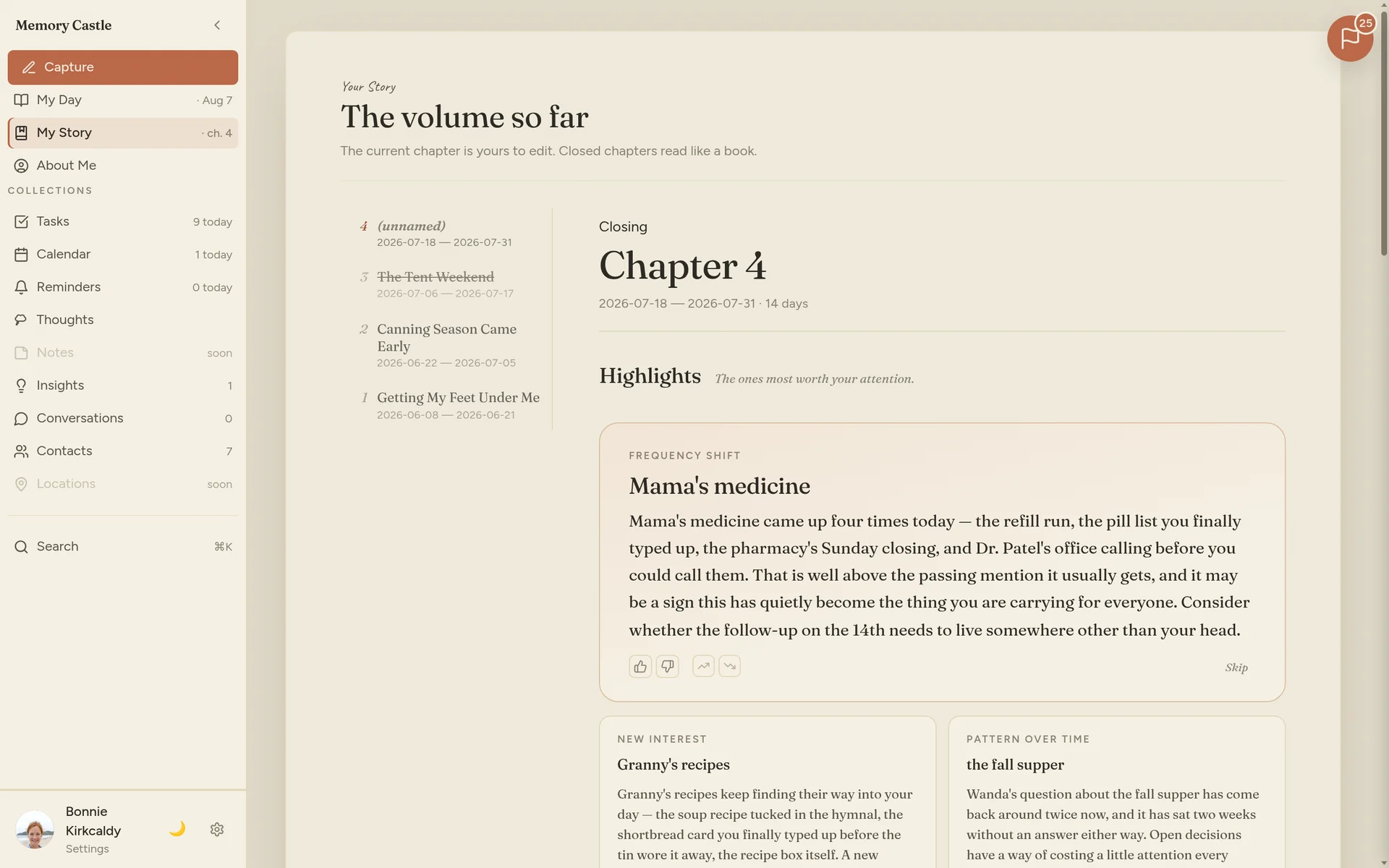
the highlights, one at a time, then the question that ends the noticing

That question is the entire session. Memory Castle has the books, which is why it goes first, but it wasn’t there. It has what you captured and none of what you meant. You were there for all of it. What worked. What didn’t. What surprised you. Three questions, every one optional, and nothing grades the answers.

Some entries will say no progress recorded, and nothing happens when they do. No color change, no gentle note about consistency, no encouragement to get back on track. The line gets reported in the same voice as every other line and the session moves on. That isn’t politeness. A number with no drama attached to it is the only kind you will ever look at twice.

Nothing in the session is an evaluation. A consultant works for you. You can tell a good one they’ve read something wrong, and they write it down instead of defending it.

Every line can be answered. A mark up when Memory Castle got it right. A mark down when it didn’t. Skip, when you’d rather keep moving, which is also an answer. A mark down means not useful right now, and Memory Castle doesn’t treat it as never.

Notice where the asking is happening. Every product you own asks you to rate something at the worst possible moment, while you’re mid-task and want the thing to go away. Nobody answers those honestly and everybody knows it. Here the question arrives at the one moment you’re already sitting down with your own life, already paying attention, already looking at the whole set at once. Feedback costs nothing when you’re in the room anyway.

The last chapter said the bar for speaking depends on you. This is where you set it. What you marked useful comes back. What you waved off comes back less. Nothing about you was guessed at from a distance. Memory Castle knows what’s worth saying because you told it, in ten minutes, once a chapter.

Then the part nobody has ever offered you. Every goal still open, every thread still running, gets one question. Does this come with you, or has it run its course?

Answering costs something, which is why nothing in your life has ever asked. Saying a thing comes with you means carrying it on purpose instead of dragging it by default. Saying it doesn’t means setting it down while you’re still looking straight at it, which is not the same as failing at it and not the same as forgetting it. Memory Castle calls that released, and prints it on the chapter’s last page beside what you carried, so you can’t later pretend it just slipped away.

Read those two lists a few chapters later and you’ll notice something worth knowing. The released things didn’t haunt you. Almost nothing a person deliberately sets down ever comes back to collect. What haunts people is the pile they never decided about.

At the bottom of the session there’s one button. Turn the Page.

A closed chapter goes onto a spine with the others, in order, under whatever name you gave it, or under no name at all if none came to mind. The bad ones stay bound in with the rest. A book with pages torn out of it isn’t a cleaner book, it’s an unreliable one.
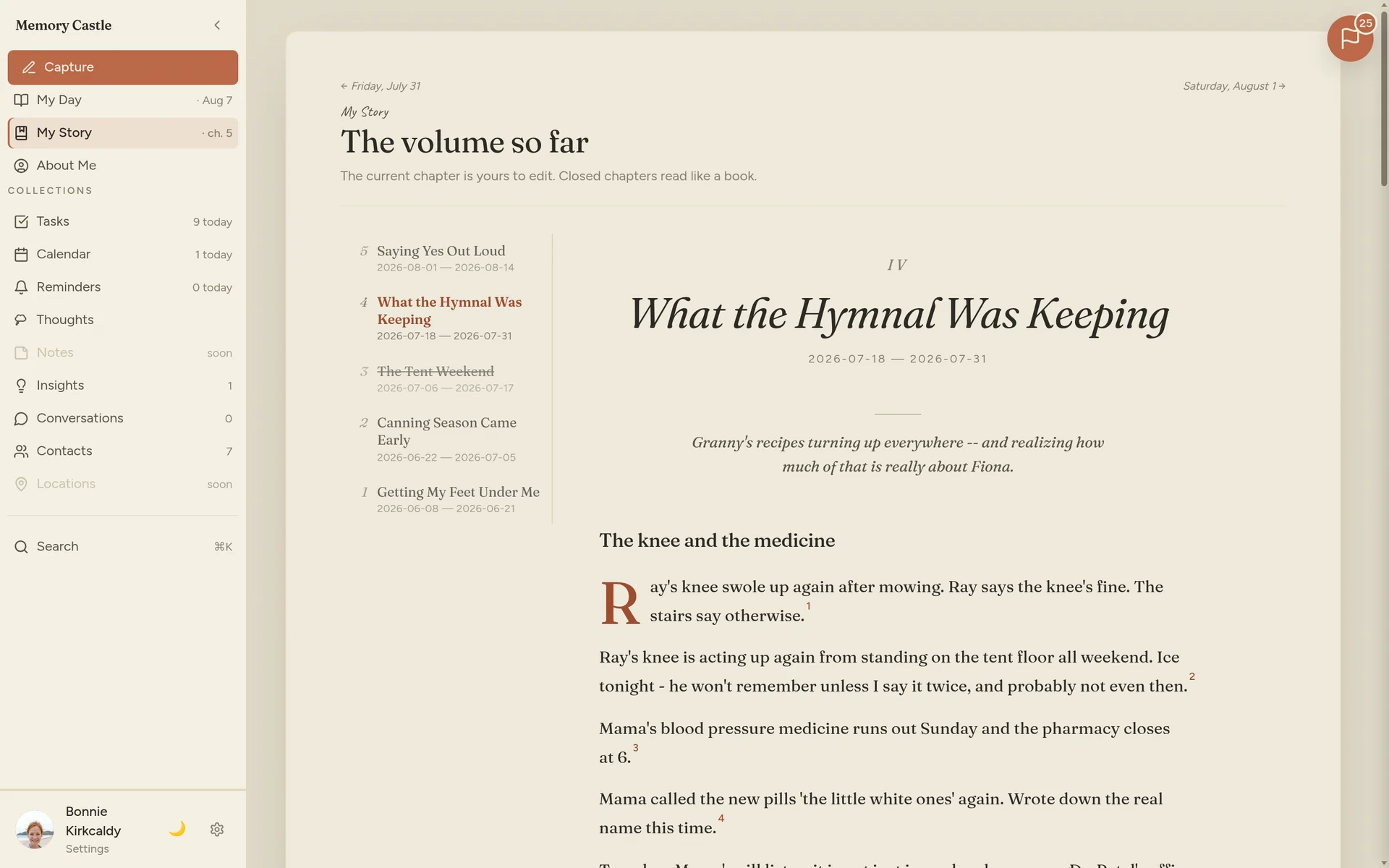
named or dated, every chapter stays bound in order

A while after the session, the chapter comes back written.

The page carries a number in roman numerals, and it opens on a line you said yourself, lifted out of your own thoughts and set at the top like an epigraph. Underneath, the weeks you lived in fragments have been gathered into the threads that were actually there. The idea you kept circling gets its own heading. So does the work you finished, and the quiet evening you almost didn’t bother to write down.

The chapter closes on two short lines, what you carried and what you released, and under them, if you left one, a sentence of your own set as a pull quote. Then a small filled square, the mark printers use to say the piece is finished.
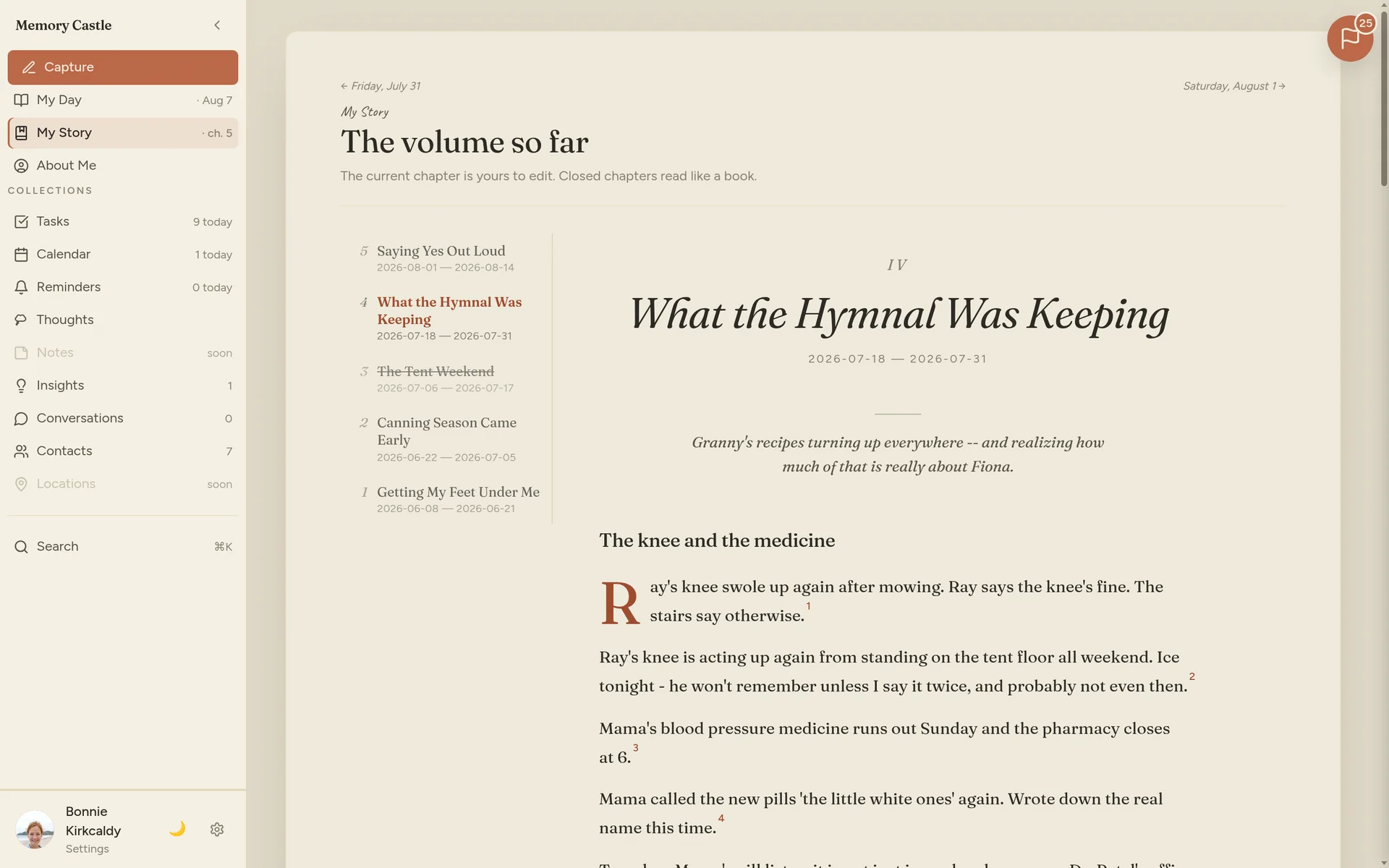
a line of your own at the top, the days that built it gathered beneath

Memory Castle generated that, which is worth stopping on. A system that writes the story of your life is either the most valuable thing here or the most alarming, and the difference is entirely in what it was allowed to do.

Memory Castle didn’t author your chapter. You did, over weeks, in pieces, without knowing at the time that’s what you were doing. Memory Castle edited it. An editor doesn’t invent. An editor arranges: what belongs together, what carries the weight, what gets left out.

Nothing on the page asks you to take it on faith. Every line points back to where it came from, and where it came from is always you. Follow one and you’re on the page for that thought, the day you had it, exactly as you left it.

Underneath is a short list of editor’s notes, where Memory Castle says what it left out, with a link to each one. A system that only ever shows you its wins is a system you stop trusting. A story about you that can’t show its sources isn’t a story about you. It’s a story about someone who doesn’t exist.

The line above the door in the first chapter said your story, kept safe. Safe from being lost is the obvious reading. Safe from anyone else is the one you probably wanted, and it goes further than you’d expect. Your chapter was written inside the castle. Your words were never sent anywhere to have it done. Nothing is studying them, nothing is training on them, and none of it is for sale. Here’s the third meaning, and it’s the one you couldn’t have known to ask for: safe from being told wrong. Even by the thing doing the telling.

Months from now you’ll read backward, not to look anything up, just to look. Somewhere near the beginning is the person who wrote those first pages, recognizably you and not you anymore, and the difference is written in your own words, which is why you won’t be able to argue with it. Those early chapters say someday. Someday I’ll get to it. Someday things will settle down. Turn forward from there and the somedays start turning into dates, the same intention said again with a week attached to it. See how far you’ve come is usually something people say to make you feel better. On those pages it’s a measurement.

The person on the sidewalk asked a fair question. Next time you’ll have something to give them, and it won’t be a better feeling about two years. It’ll be the two years, closed and counted and written down. What matters more is having them on the ordinary Tuesday when nobody’s asking. Two years of evidence that you actually move changes what you’re willing to try in the next two.

‹ Hear Yourself Out Join the waitlist Next: Become Who You Said You'd Be ›