

The Waitlist
Be there when the gates open.
Become Who You Said You'd Be
In this book so far: you've captured the days, heard them back, and closed a chapter on purpose.
Nobody builds a house by showing up each morning and doing whatever seems most urgent.
There’s a drawing first, and the drawing settles what carries the weight before anyone argues about the kitchen. Skip it and you rarely get a collapse. What you get is the house everyone has been inside once: a bathroom you reach through a bedroom, a step down into the kitchen that nobody can explain, a room no one uses. Every part of it made sense on the day it was added. Nobody ever drew the whole thing.
Your life is being built that way right now.
You know how to plan. You’ve done it carefully for things that mattered less than this. What you have never once done is sit down before a stretch of your own life and decide what it’s for.
That isn’t laziness. Doing it honestly would mean holding the whole thing in your head at the same time: every goal, every role, what slipped last month, what’s due, what you keep moving to next week, and which of those actually matters as against which merely has a date on it. Nobody can hold that. So you plan the parts that are shouting, and the quiet ones lose again, the way they lost last month.
They lose for a reason that has nothing to do with willpower. An intention has no time in it. Anything without a time attached competes every day against everything that has one, and loses, and will go on losing until somebody puts it on a calendar and defends it there.
Some people’s time is treated as expensive. Somebody builds their quarter for them, or shapes their season, and nobody calls that indulgent, because their output is understood to be worth engineering. The arrangement isn’t really about money. It’s about somebody having decided that this person’s hours ought to add up to something in particular.
Nobody has ever decided that about yours. You haven’t either.
Personal growth management is that decision, made about your own hours, by the only person with standing to make it.
Memory Castle plans the next stretch with you, and it arrives at that session the way it arrived at the last one, having already done the work.
Every planner ever sold hands you an empty week and asks you to fill it in with your priorities. The empty week is the reason nobody does it. A blank page asks you to produce, out of memory and under time pressure, an honest ranking of your entire life. That was never a reasonable thing to ask of anyone at nine o’clock on a Sunday night.
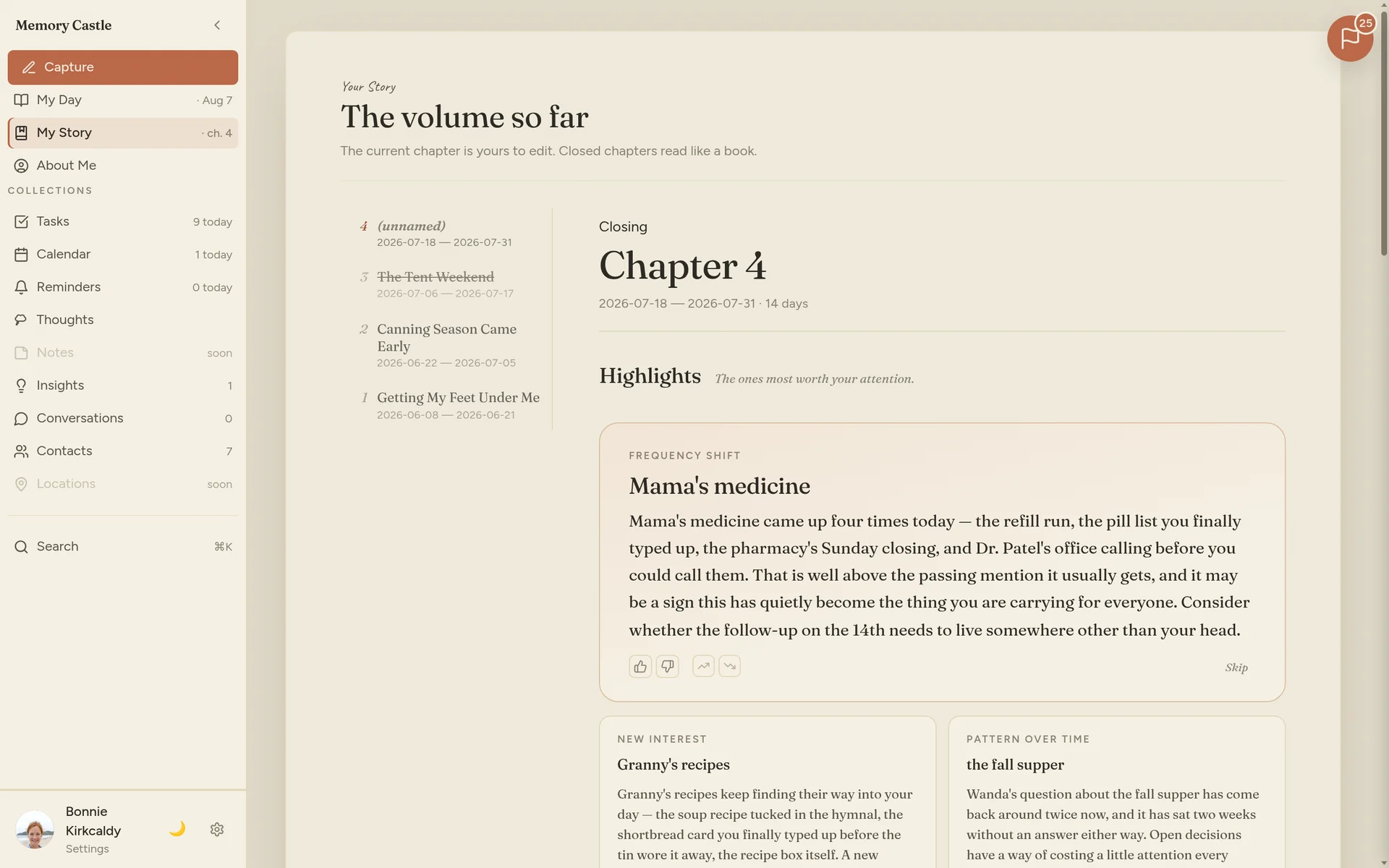
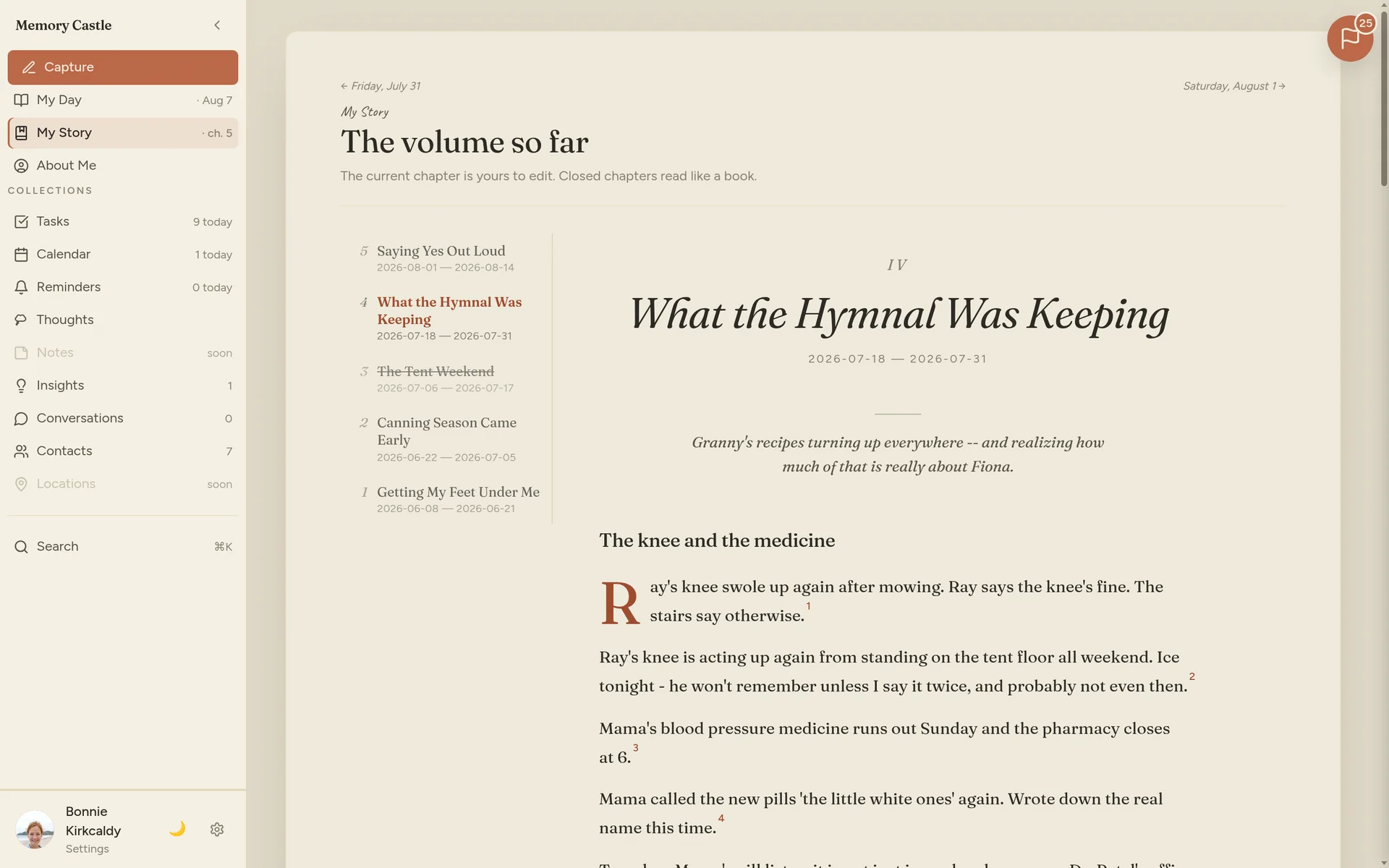
The page isn’t blank here. Memory Castle has read every chapter you’ve closed, so it comes with a draft.
All of them, not just the recent ones, and the older chapters count for less. That’s a small piece of arithmetic deciding something large. A record that weighed your worst month exactly as heavily as your last one would be a record that never lets anybody change. Who you were three chapters ago is still in there. It just doesn’t weigh as much as who you’ve been lately.
The session you just finished doesn’t end. It turns. One half closed the chapter behind you; the other half opens the one in front, in the same sitting, because deciding what comes next is only honest while what just happened is still in front of you.
You give the next chapter a name, if a name comes to you, and you say how long it runs. Naming a stretch of your life before you’ve lived it is a strange feeling the first time. It’s also the whole difference between a stretch of time and a chapter.
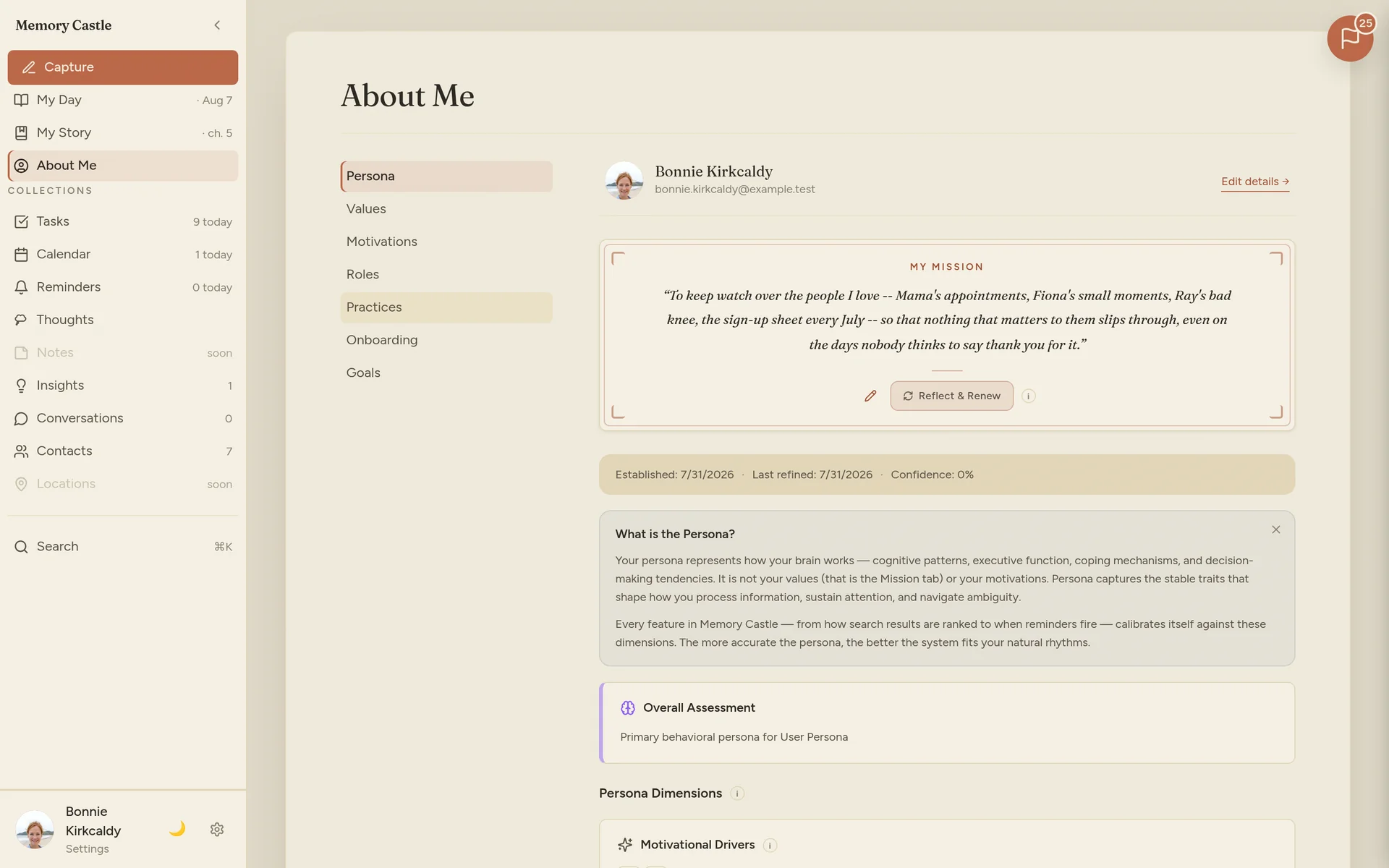
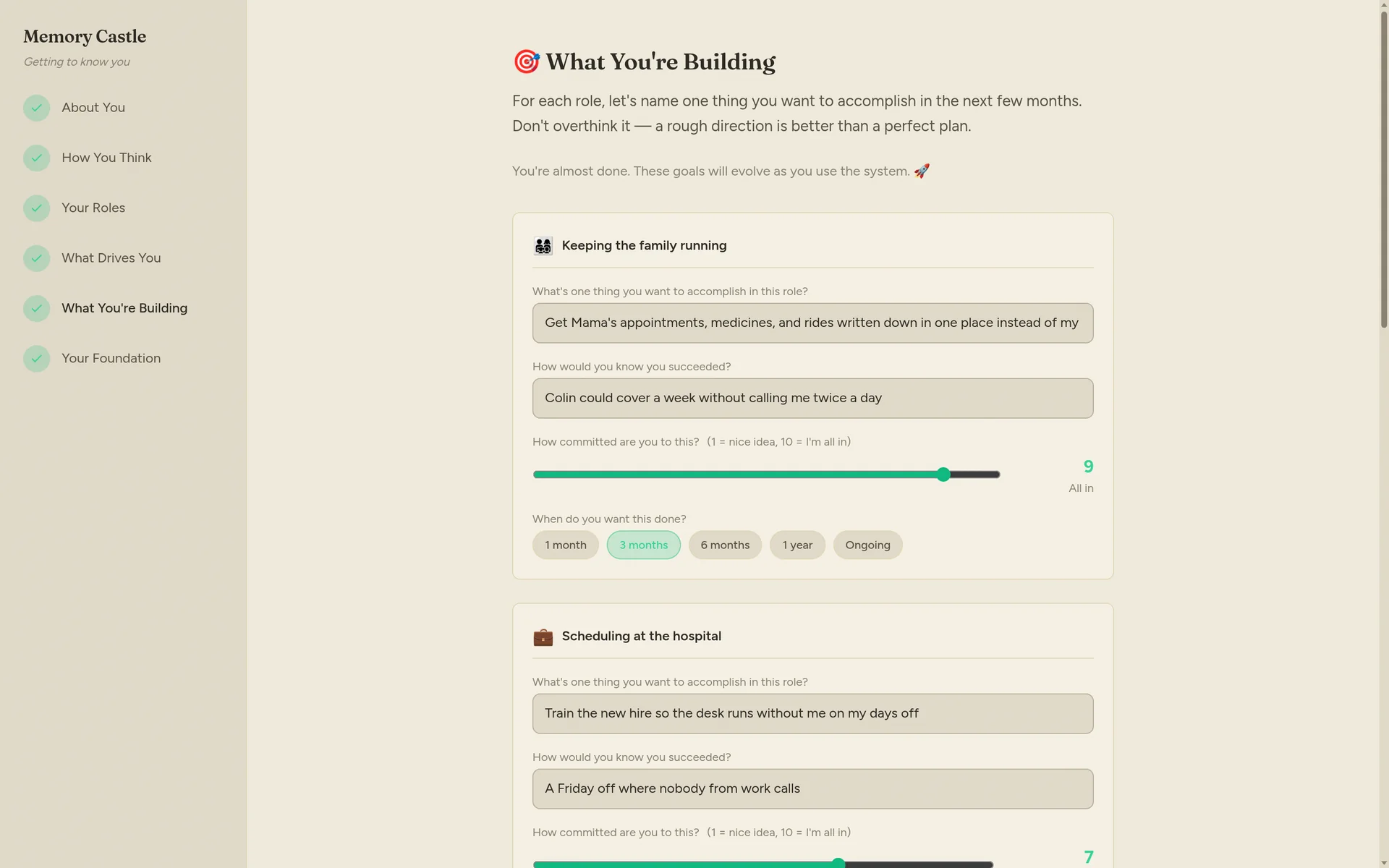
Then the keystones, which are the few goals you’ve chosen to let this chapter rest on.
You can’t work every goal at once. Every other app you’ve tried expects you to, which is what a list of forty things actually is: a standing demand that you fail at thirty-seven of them daily. Choosing a few isn’t a compromise you’re making. It’s the only version of this that has ever worked for anybody, and the reason the drawing gets made before the kitchen gets argued about.
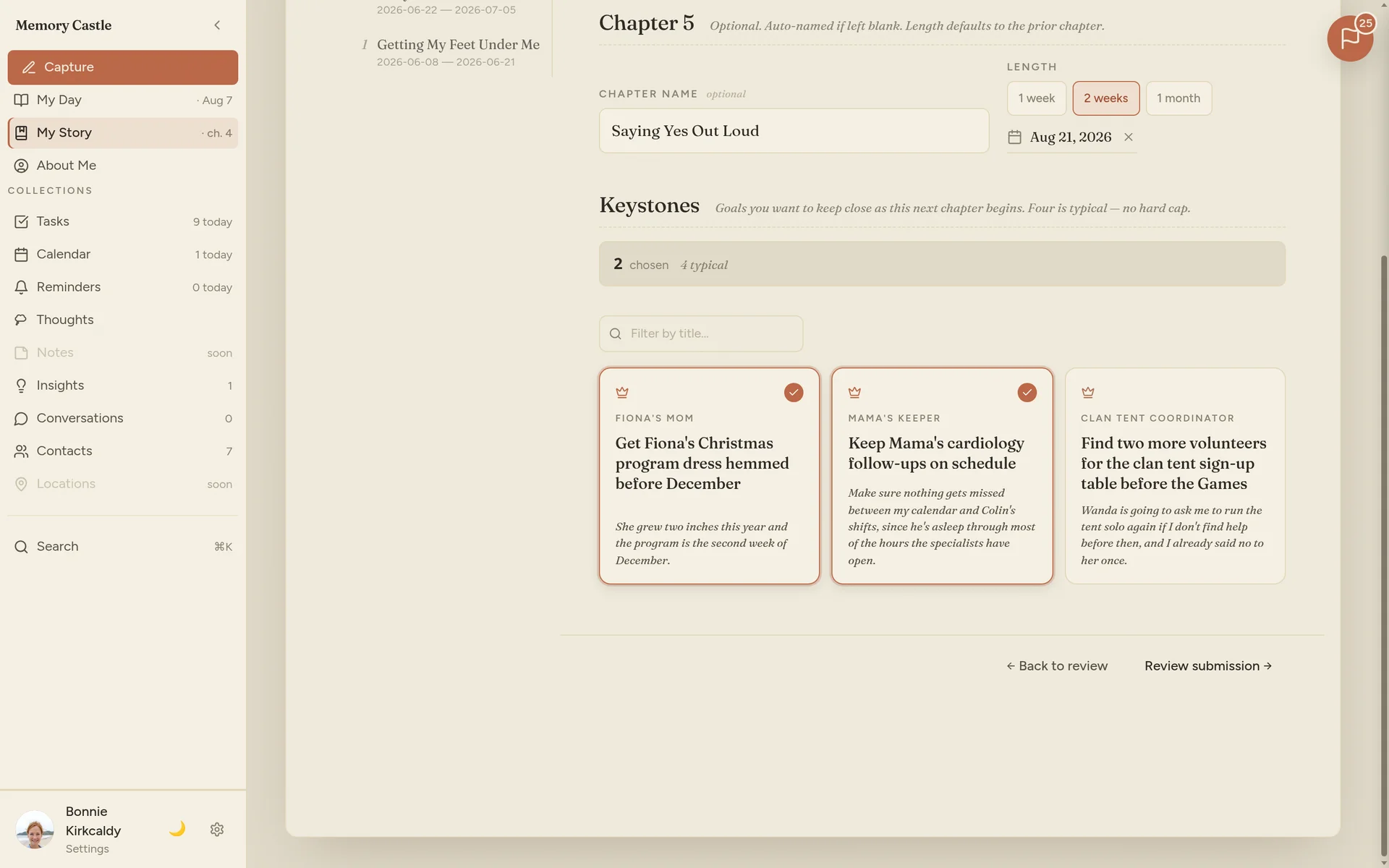
Last chapter’s keystones are already selected when you arrive. You deselect what no longer applies instead of rebuilding the set from nothing, and that ordering is doing something quietly. Continuing is the default. Stopping is a thing you have to reach over and do. Everywhere else in your life the opposite is true, which is how most of what you cared about ended.
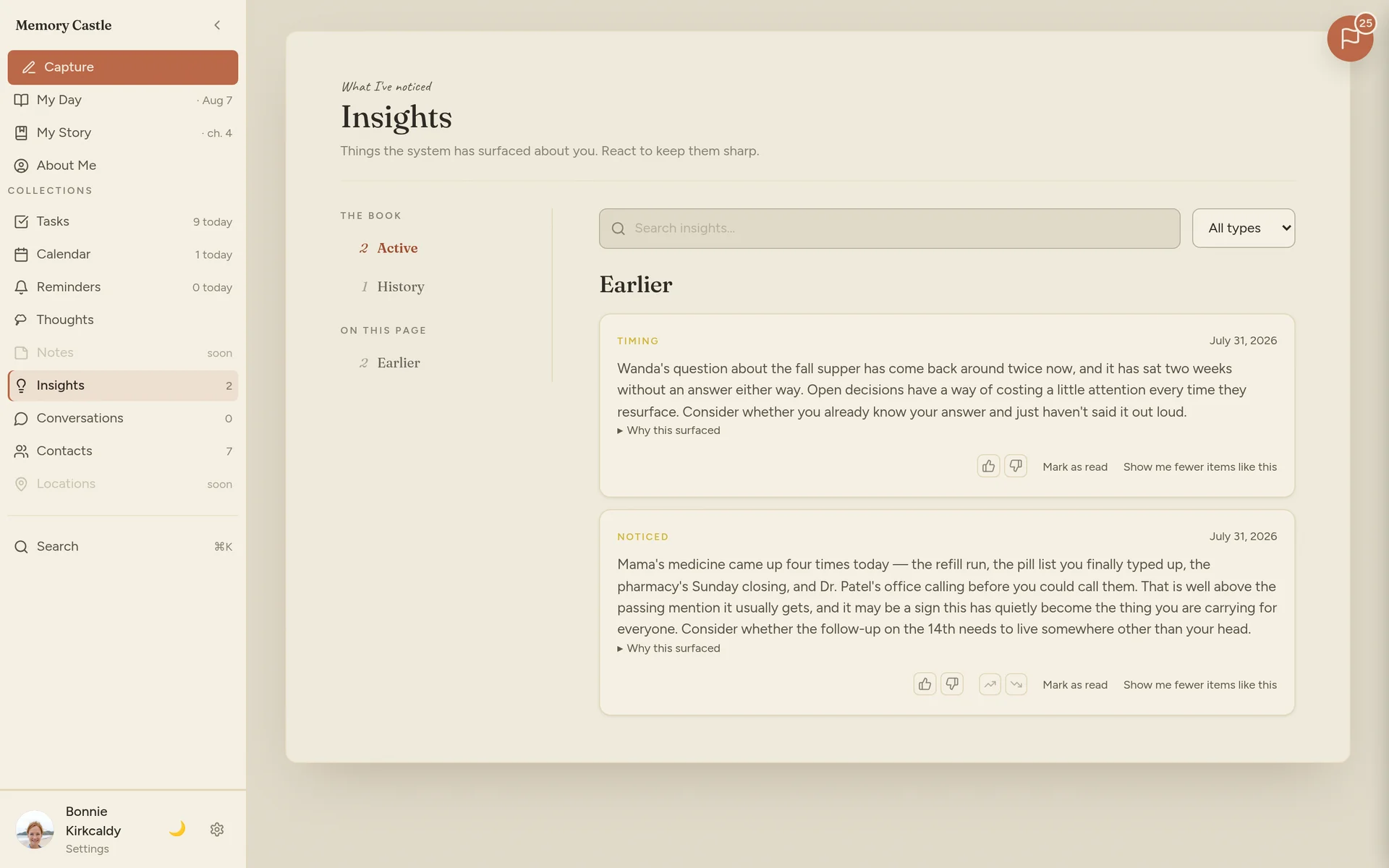
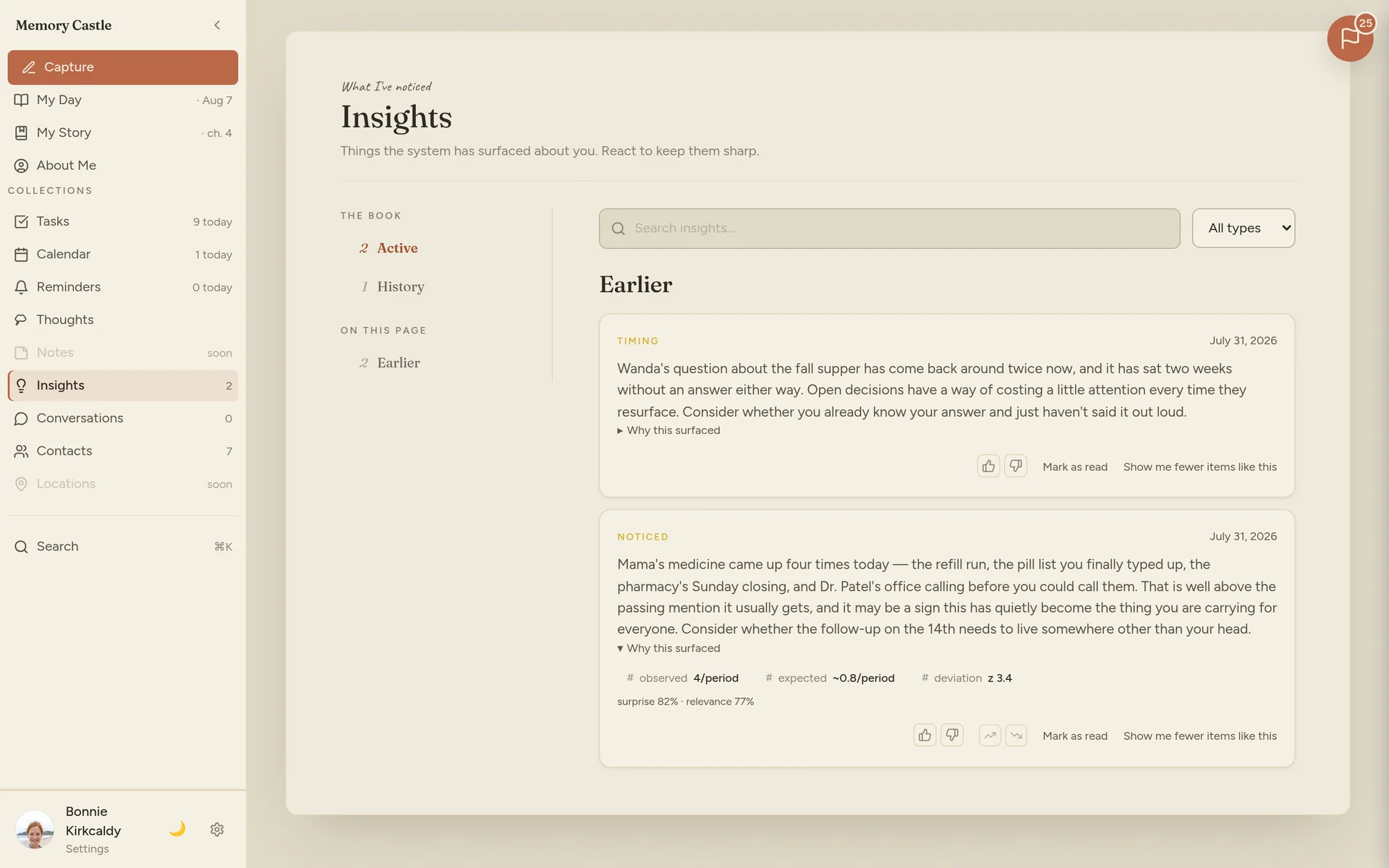
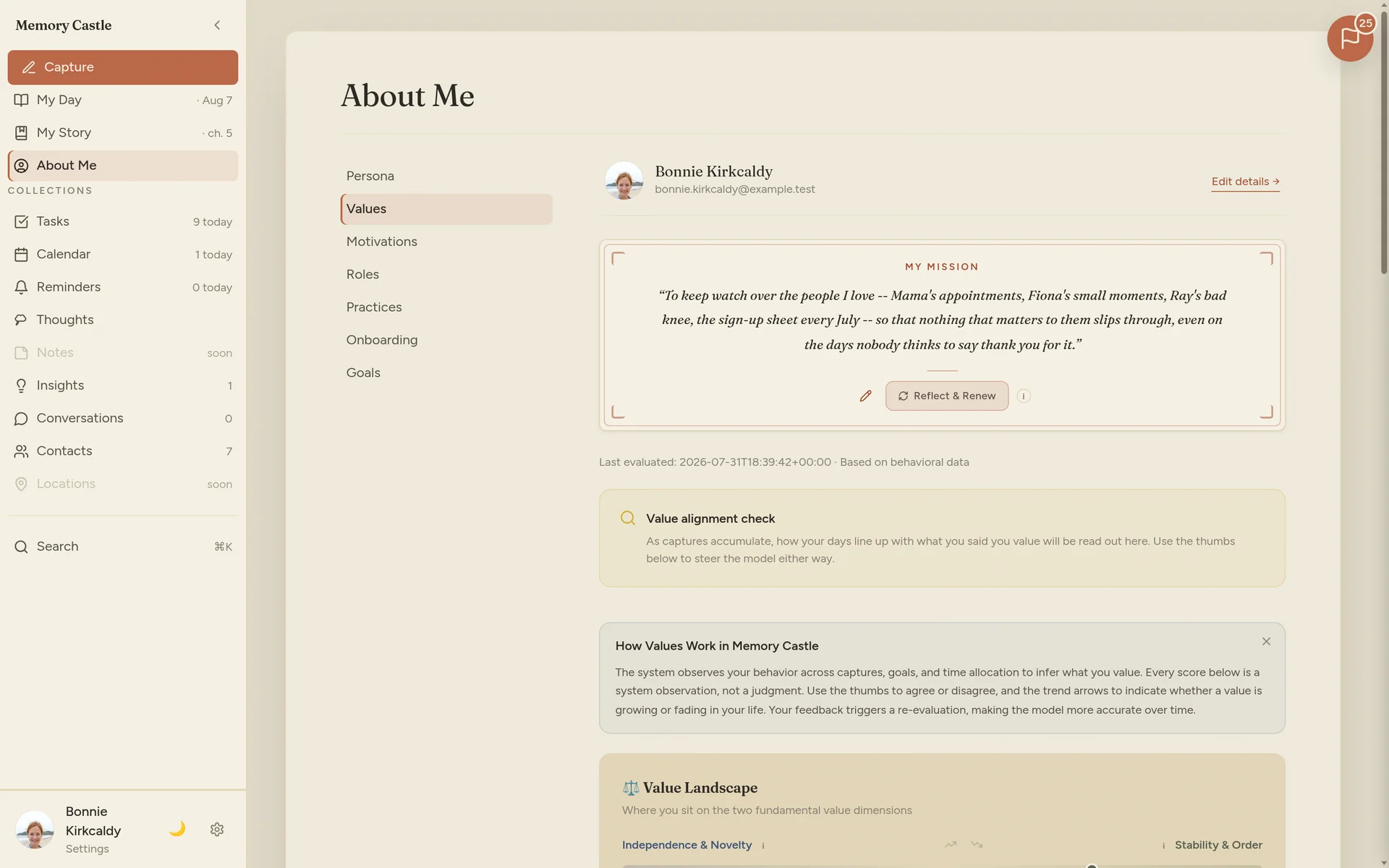
Memory Castle proposes as well, and this is where every chapter you’ve lived gets spent. The goals you named at the very beginning were a seed, written by somebody who had never seen a single piece of evidence about themselves. Since then you’ve been living out loud, and it has been reading.
Some of what it proposes you’ll recognize. Some of it you won’t. A goal you have clearly been pursuing for two chapters and never once wrote down. A practice your own days already show three or four times a week that you’d have sworn was occasional.
Some of it is stranger than that, and more useful. A motivation you named at the very beginning that has nothing attached to it. No goal, no practice, nothing that could ever cause it to happen. A wish, sitting in the place where a direction was supposed to be.
Or the opposite, which is the one worth staying for. You kept a practice faithfully for two chapters. You did the thing. The goal it was supposed to serve hasn’t moved at all. Every system you have ever used would let you draw the obvious conclusion about yourself there. This one says the practice is happening and the connection isn’t, and asks whether it was ever attached to the right goal. Nobody has offered you that reading before. It’s usually the true one.
The suggestions are shaped by more than what you said you wanted. Back at the beginning you answered a pile of situations that had no right answers, the lumber in the yard and the neighbor’s invitation. That is what those were for. A plan built for somebody who abandons things once they get tedious should not look like a plan built for somebody who finishes everything three days late. Yours is built for how you actually decide.
From the keystones comes the plan. Things to do, sized so that starting is possible. Time set aside on real days for the work that never shouts, because that work has now been given the one thing it never had, which is an hour with its name on it.
The unfinished things from last chapter get handled instead of carried. Each one gets a decision. Move it somewhere real, or cut it into pieces small enough that beginning is possible. A task you have moved four times isn’t a discipline problem. It’s usually a task that was never small enough to start, and nobody has ever told you that’s an ordinary thing that happens to a task rather than an ordinary thing that’s wrong with you.
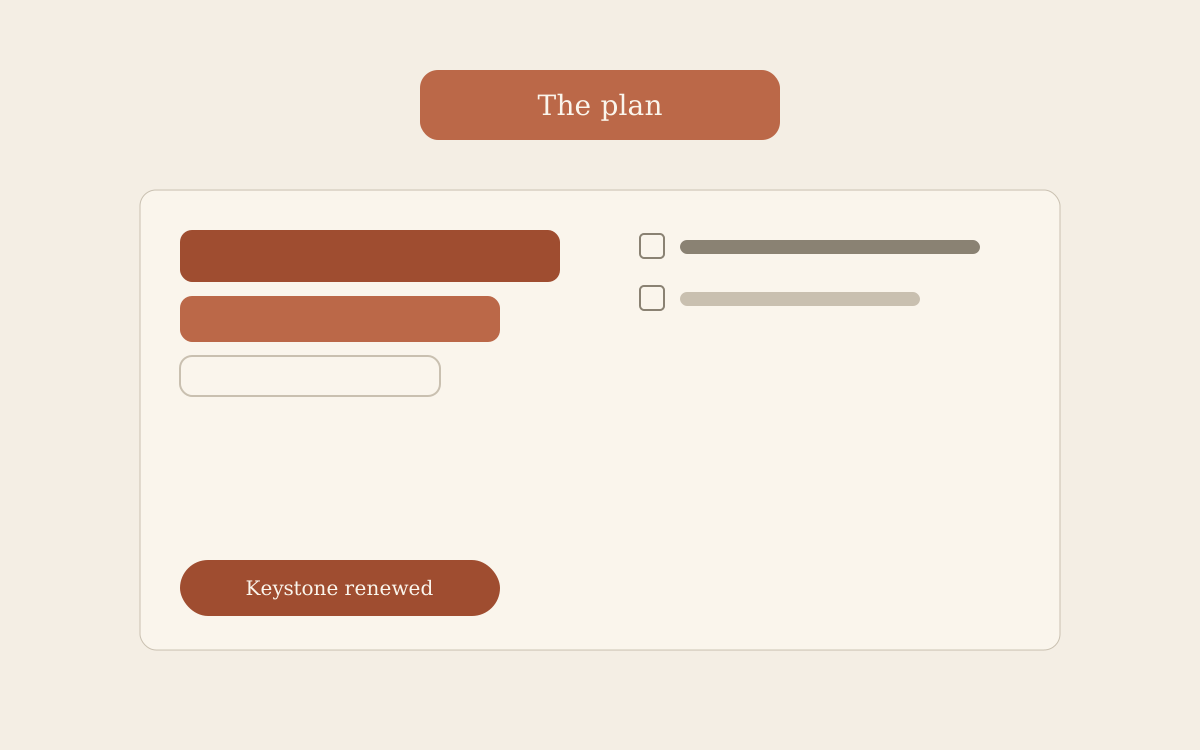
Then you put your name on it. Not a promise of perfection. A commitment to the person you said you wanted to be, written down where it can be compared against how you actually spend the chapter.
Life will arrive mid-chapter the way it always does, and the plan is built to bend when it does. A deadline that can’t hold gets moved. A task you can’t start gets cut smaller. Nothing follows you around about any of it. A plan that can’t bend gets abandoned the first week something goes wrong, and something goes wrong every week.
Memory Castle isn’t checking up on you. Memory Castle is keeping the plan somewhere you can see it and saying so when your days and the plan stop matching. Those are different jobs, and only one of them has ever helped anybody.
A plan made on a Sunday is invisible by Wednesday. Not forgotten, exactly. Nothing in a Wednesday mentions it. Your calendar doesn’t know what the chapter is for, your inbox has never heard of it, and the day fills up with things that arrived on their own.
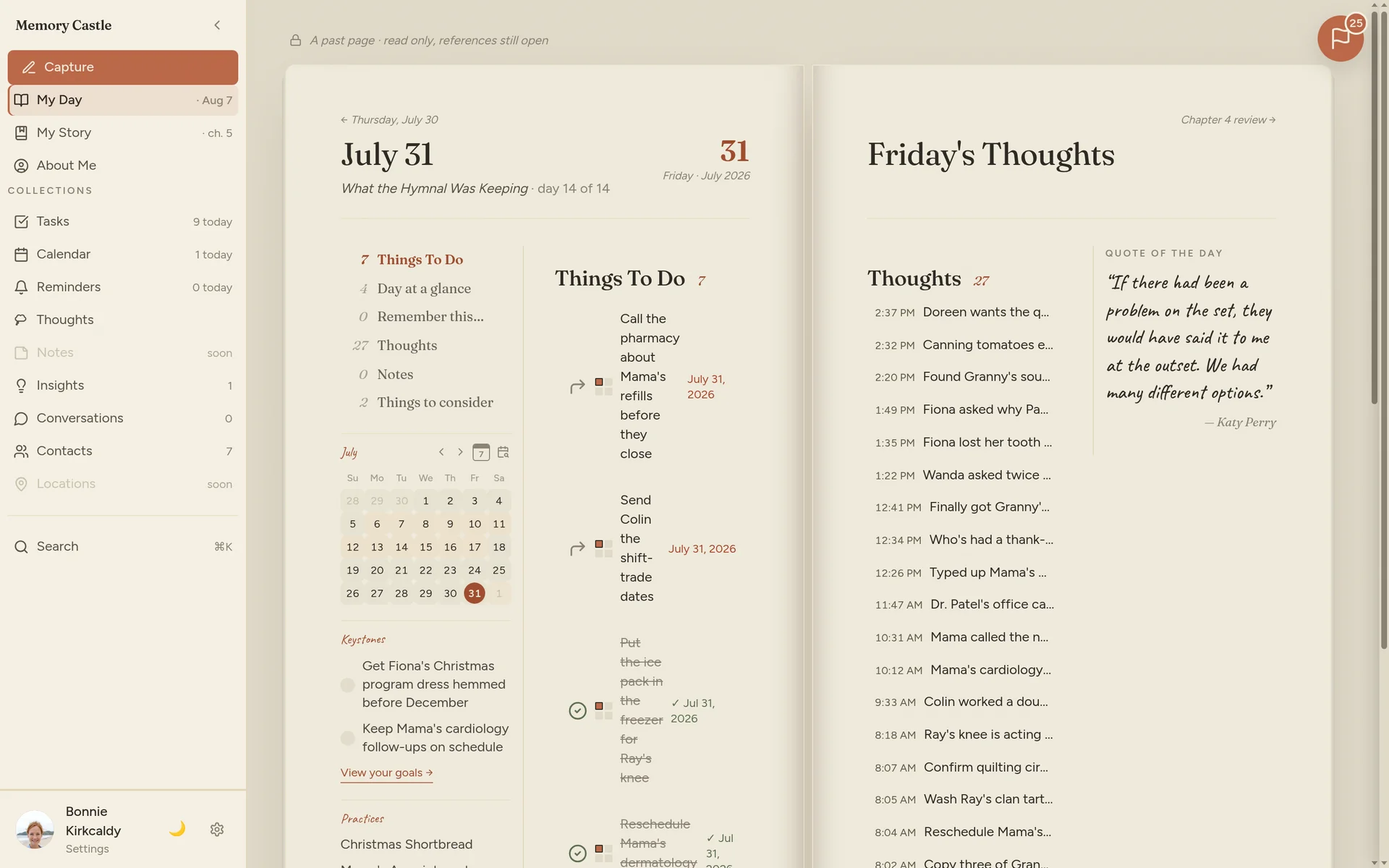
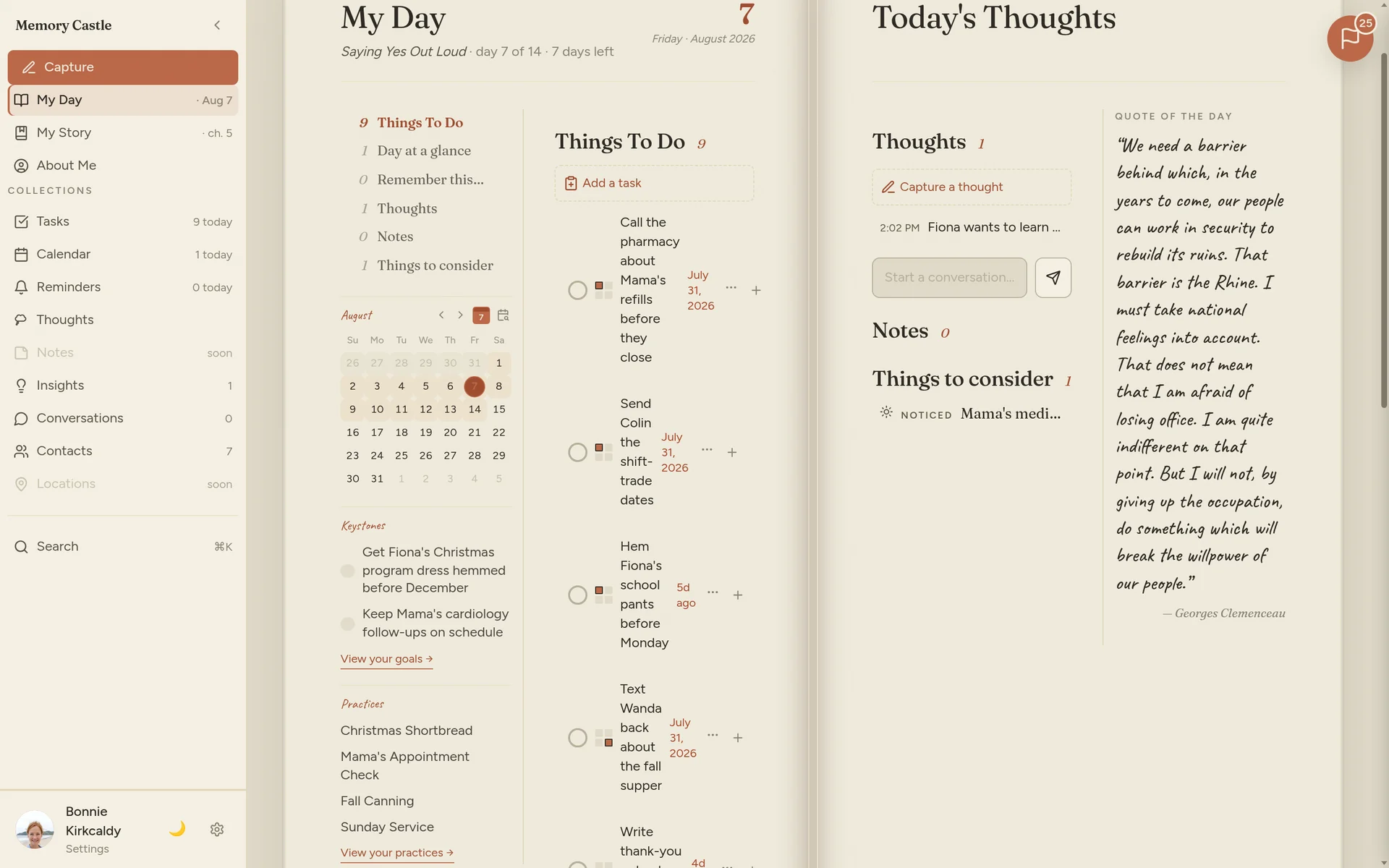
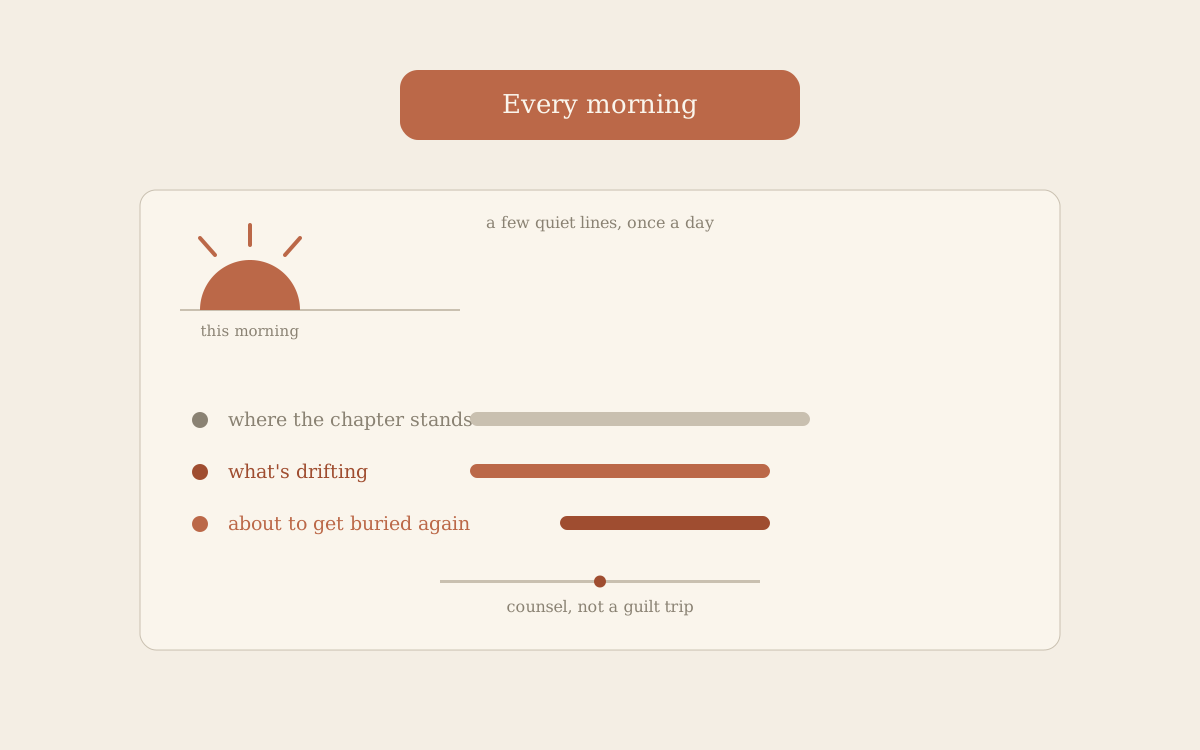
That’s what the mornings are for. Memory Castle is ready when you are, having already been through yesterday’s tasks and events and thoughts, so it knows what got done and what slipped without having to ask. A few quiet lines about where the chapter stands, what’s drifting, and the thing you said mattered that’s about to get buried under a Tuesday. No scolding, no tally of what you owe. It proposes, you decide.
When you finish the session there’s no ceremony. No congratulations, no medal for having reflected. The chapter behind you is closed, the one in front of you is open, and there’s one way forward from there, which is to go and live it out loud.
Then you do all of it again. That isn’t a disappointment, it’s the point. Anything you can finish is a program, and programs stop working the week after you finish them. Your story has no last page, which is the only honest shape for something meant to keep up with a life.
Becoming who you said you’d be was never going to happen because you decided it. Deciding is where everyone starts, which is why everyone believes the deciding is the hard part. It isn’t. It happens because an ordinary Tuesday in the middle of an ordinary week got arranged so that it could, by somebody who knew what you said you wanted and could see what you’d actually been doing. That somebody is you. Not working from memory this time, but from careful consideration, with Memory Castle’s guidance behind every line of it.